
King James Version Versus Modern Bible Translations: Which Is More Faithful to God’s Word?
INTRODUCTION — IS THE KING JAMES VERSION THE ONLY TRUSTWORTHY BIBLE?
The King James Version (KJV) is one of the most influential Bible translations in Christian history. For centuries, it has helped millions of people understand Scripture and discover the wonderful message of salvation through Jesus Christ.
However, does this mean that the KJV is the most accurate Bible translation, or that Christians should avoid modern translations such as the New King James Version (NKJV), New American Standard Bible (NASB), English Standard Version (ESV) or New International Version (NIV)?
I greatly appreciate Walter Veith and his ministry, but I respectfully disagree with his position concerning the superiority of the KJV and his warnings about modern Bible translations.
I believe no translation is perfect, including the KJV. Every translation is produced by human beings who must interpret ancient Hebrew, Aramaic and Greek words, grammar and historical context.
Personally, I mainly use the NKJV for reading and making notes. However, I regularly compare it with other translations, especially the NASB, NIV and ESV. I also consult biblical dictionaries, Hebrew and Greek lexicons and different commentaries.
This has helped me discover important meanings that are sometimes obscured by traditional English wording.
Furthermore, the KJV uses archaic English that is often difficult to understand even for native English speakers. For those of us who learned English as adults, the difficulties are considerably greater.
I believe our loyalty should be to the inspired Word of God, not to any particular English translation.
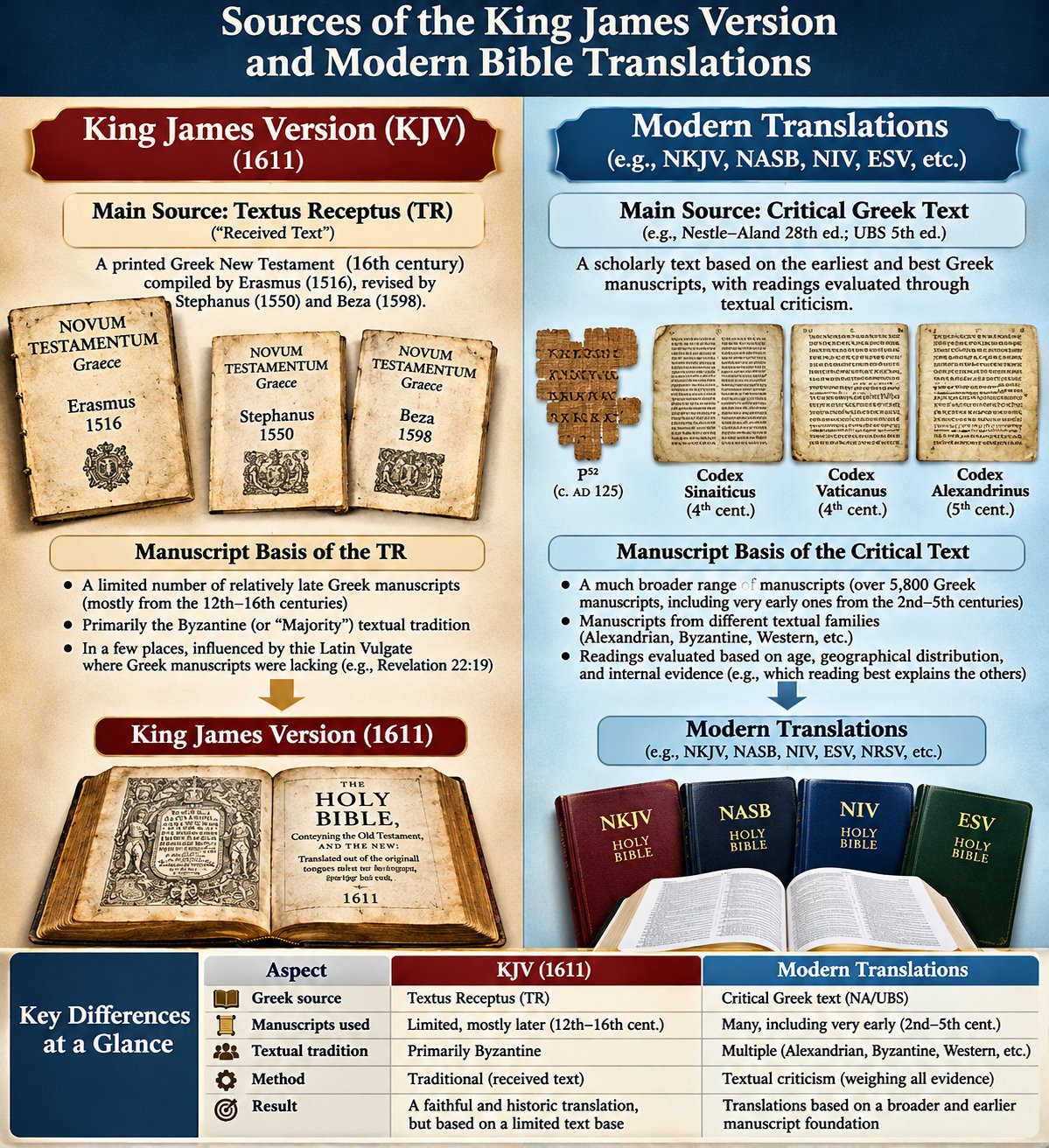
Some Christians claim that the King James Version (KJV) is the only trustworthy English Bible and that modern translations have removed God’s Word. But historical evidence shows that the KJV itself contains errors or words and verses that were added long after the Bible was originally written.
1. How Was the King James Bible Created?
In 1604, King James I of England ordered a new English Bible. About 50 scholars worked on the translation, which was published in London in 1611. The translators used later handwritten copies, printed editions and earlier translations.
Old Testament — Hebrew and Aramaic
The Old Testament was originally written mainly in Hebrew, with a few passages in Aramaic, over many centuries before Christ. The KJV translators mainly used the Masoretic Text, a Hebrew text preserved by Jewish scholars called Masoretes. They worked especially between AD 600 and 1000 in Tiberias (present-day Israel) and Babylonia (present-day Iraq). The translators relied particularly on a printed Hebrew Bible prepared by Jacob ben Chayyim and published in Venice, Italy, in 1524–1525.
They also consulted other ancient translations:
- Septuagint: A Greek translation of the Old Testament, begun in Egypt around the third century BC.
- Latin Vulgate: A Latin Bible prepared mainly by Jerome around AD 382–405.
- Aramaic Targums: Ancient Jewish translations and explanations of the Hebrew Scriptures.
New Testament — Greek
The New Testament was originally written in Greek during the first century AD. The KJV translators mainly used Greek editions published by Theodore Beza in 1588–1589 and 1598. These were based largely on earlier editions by Stephanus (1550) and Erasmus (1516).
They also used earlier English Bibles, especially the Bishops’ Bible and translations by William Tyndale.
2. Erasmus: The Catholic Priest Behind the KJV’s Greek Text
Desiderius Erasmus (1466–1536) was a Dutch Catholic priest and scholar who remained Catholic throughout his life. In 1516, in Basel, Switzerland, he published a Greek New Testament using only a handful of relatively late Greek manuscripts, mostly from the 12th to 15th centuries. His first edition was prepared in a hurry and contained numerous printing errors. Some manuscripts were incomplete. For the final six verses of Revelation, Erasmus had no Greek manuscript text, so he translated them from the Latin Bible back into Greek.
Other scholars later revised his text. These editions became known as the Textus Receptus, meaning “Received Text“. The name became established in 1633, after the KJV was published.
The problem is not that Erasmus was Catholic, but that his Greek text contained errors and later additions that were carried into the KJV.
3. Important Errors and Later Additions in the KJV
| Bible passage | Problem in the KJV | Better-supported reading or evidence |
|---|---|---|
| Romans 8:1 | Adds “who walk not after the flesh, but after the Spirit”. | These words were copied from verse 4. The earlier text declares no condemnation for those in Christ, without this additional condition. |
| 1 John 5:7–8 | Adds the Father, Word and Holy Ghost as three heavenly witnesses. | The words are absent from early Greek manuscripts and are a later addition. |
| Revelation 22:19 | Says “book of life”. | Earlier Greek manuscripts say “tree of life”. Erasmus introduced the Latin-derived reading. |
| Acts 9:5–6 | Adds words to Jesus’ conversation with Saul. | The longer wording is absent from early Greek witnesses and draws on other accounts of Paul’s conversion. |
| John 5:4 | Says an angel stirred the water at Bethesda. | This explanation is absent from the earliest surviving Greek manuscripts. |
| Acts 8:37 | Includes the Ethiopian’s confession before baptism. | The verse is absent from important early Greek manuscripts. |
| Matthew 18:11 | Adds a verse about the Son of Man saving the lost. | Probably copied from Luke 19:10. |
| Matthew 17:21 | Includes an entire verse about prayer and fasting. | Absent from important early Greek manuscripts. |
| Mark 1:2 | Says “As it is written in the prophets”. | The earlier reading is “in Isaiah the prophet”, although the quotation combines Malachi and Isaiah. |
| Matthew 24:36 | Omits “nor the Son” from Jesus’ statement about the unknown day and hour. | Important early manuscripts include these words. |
| Luke 2:33 | Calls Joseph “Joseph” rather than Jesus’ “father”. | Earlier Greek witnesses read “his father and mother”. |
| Mark 16:9–20 | Includes twelve verses without a textual warning. | Missing from two major fourth-century manuscripts, but known in the second century. Its originality remains disputed. |
| John 7:53–8:11 | Includes the woman caught in adultery without a textual warning. | Absent from the earliest Greek manuscripts of John and found in different locations in some later copies. |
Why Romans 8:1 Is Particularly Important
In the earlier Greek text, Paul declares that believers who are in Christ Jesus are free from condemnation. The KJV adds words about walking according to the Spirit, which can make freedom from condemnation appear dependent on Christian behaviour rather than on being in Christ, which transforms the gospel into a subtle form of legalism! The NASB and other modern translations correctly follow the shorter, better-supported Greek text in Romans 8:1.
What This Evidence Proves
These examples show three different problems with the KJV:
- Added words: Romans 8:1, 1 John 5:7–8 and Acts 9:5–6.
- Incorrect readings: Revelation 22:19 and Mark 1:2.
- Omitted words: Matthew 24:36 and Luke 2:33.
The NASB generally follows better-supported Greek readings in these examples. This is strong evidence that the KJV is not the only reliable Bible and that modern translations can preserve the original wording more accurately.
1 John 5:7–8 — Words Added About the Trinity
The KJV says: “For there are three that bear record in heaven, the Father, the Word, and the Holy Ghost: and these three are one.” (1 John 5:7, KJV). These words are absent from the early Greek manuscripts. Erasmus left them out of his first two editions because his Greek manuscripts did not contain them. He added them in 1522 after examining a very late Greek manuscript. Scholars overwhelmingly regard these words as a later addition, not part of John’s original letter. This does not disprove the Trinity, which must be studied using other biblical passages.
Revelation 22:19 — A Mistake Caused by Translating Latin into Greek
The KJV reads “book of life”, while the earlier Greek manuscripts read “tree of life” (Revelation 22:19). Erasmus’s Greek manuscript lacked the final six verses of Revelation. He translated them from Latin back into Greek, introducing readings not supported by the earlier Greek manuscripts.
The KJV retained “book of life”, while the NASB follows the earlier Greek reading, “tree of life”.
Other Disputed Passages
Matthew 17:21, Mark 16:9–20 and John 7:53–8:11 are also disputed because they are absent from important early manuscripts.
The evidence is not equally strong in every case. For example, Mark 16:9–20 was already known in the second century, although it is missing from two major fourth-century Greek manuscripts.
Daniel 8:14 — Another Example Where a Modern Translation Is Better Than the KJV
Many Seventh-day Adventist theologians and authors favour the KJV because it translates Daniel 8:14 as “then shall the sanctuary be cleansed”, which appears to support the Adventist teaching about the cleansing of the heavenly sanctuary. Some even use this verse as an argument for the superiority of the KJV over modern Bible translations. However, a closer examination of the original Hebrew and the context of Daniel 8 suggests that even in this case, a modern translation may be better.
The Amplified Bible (1987) gives a fuller meaning: “then the sanctuary shall be cleansed and restored”.
The original Hebrew word nitsadaq, derived from tsadaq, has a broader meaning than simply “cleansed”. It also conveys the ideas of justification, vindication and restoration. This explains why Daniel used tsadaq rather than tahar, the Hebrew word for cleansing used in Leviticus 16.
According to the Adventist interpretation, the heavenly sanctuary needed not only to be cleansed from the record of the forgiven sins of God’s people, which would ultimately be transferred onto the head of Azazel (Satan), but also to be restored and vindicated because the little horn had distorted the true gospel and Christ’s heavenly ministry (Daniel 8:11–13).
As Pastor Jack Sequeira explained, the little horn, identified in historic Adventist interpretation with papal Rome, replaced the pure gospel of God’s unconditional agape love and salvation entirely by grace with a distorted caritas gospel, combining God’s grace with human works as a basis for salvation. By obscuring Christ’s sufficient sacrifice and His ministry as our only High Priest, this false gospel symbolically polluted the heavenly sanctuary and cast its truth to the ground.
Therefore, Daniel 8:14 points to three aspects of the sanctuary’s restoration: cleansing it from the record of forgiven sins, restoring the true gospel and Christ’s heavenly ministry, and vindicating God’s character, His justice and His faithful people through the heavenly judgment (Daniel 7:9–10, 22).
The KJV’s “cleansed” is not wrong, but it expresses only part of this broader meaning. The Amplified Bible’s “cleansed and restored” better reflects the Hebrew word tsadaq and the full context of Daniel 8:11–14.
4. How Was the New American Standard Bible (NASB) Created?
The NASB was produced by the Lockman Foundation, an American Christian organisation, with a team of Bible scholars. Work began in 1959. The New Testament appeared in 1963, the complete Bible in 1971, and revised editions in 1977, 1995 and 2020. The NASB aims to translate the original Hebrew, Aramaic and Greek as closely as possible into understandable English. This is called a literalorword-for-word approach.
Old Testament — Hebrew and Aramaic
The NASB 2020 mainly uses two modern scholarly editions of the Hebrew Bible:
- Biblia Hebraica Stuttgartensia: Published in Stuttgart, Germany, between 1967 and 1977, and based mainly on the Leningrad Codex, a Hebrew manuscript dated AD 1008/1009.
- Biblia Hebraica Quinta: A newer Hebrew edition published in parts since 2004, also based on the Leningrad Codex but with updated comparisons of other manuscripts.
The translators also consulted the Dead Sea Scrolls, the Septuagint, the Aramaic Targums and other ancient translations.
The Dead Sea Scrolls, discovered beginning in 1947 near the Dead Sea, include Hebrew and Aramaic biblical manuscripts dating from approximately the third century BC to the first century AD. They provide evidence more than a thousand years older than the medieval Hebrew manuscripts.
New Testament — Greek
The NASB 2020 mainly uses the Nestle-Aland 28th edition, published in 2012, together with more recent manuscript research.
This Greek text draws on a much wider range of evidence than Erasmus had, including:
- Early Greek papyri: Some surviving New Testament manuscripts date from the second and third centuries AD.
- Codex Vaticanus: A fourth-century Greek Bible manuscript preserved in the Vatican Library.
- Codex Sinaiticus: A fourth-century Greek Bible manuscript, with major portions preserved in the British Library.
- Later Greek manuscripts: Thousands of additional handwritten copies from subsequent centuries.
The NASB translators could therefore compare manuscripts from different periods rather than depend on the limited collection available to Erasmus.
5. KJV and NASB: The Main Differences
| KJV (1611) | NASB (2020) | |
|---|---|---|
| Old Testament | Traditional Hebrew Masoretic Text | Scholarly Hebrew editions checked against additional ancient evidence |
| New Testament | Greek editions descended largely from Erasmus’s work | Modern critical Greek text based on a much wider range of manuscripts |
| Dead Sea Scrolls | Not available | Consulted |
| Early New Testament papyri | Largely unavailable | Included in textual research |
| Later additions | Often included without warning | Usually omitted or explained in footnotes |
| English | Early modern English | Modern, relatively literal English |
The NASB 2020 publishers explain that several verses found in the KJV were moved to footnotes because the manuscript evidence shows that they were added by later copyists. These include Matthew 17:21, Matthew 18:11, John 5:4 and Acts 8:37, Romans 8:1, etc.
6. Conclusion: Is the NASB More Reliable Than the KJV?
The NASB generally has a stronger manuscript foundation, especially for the New Testament.
The KJV translators worked with the best sources available to them in the early 1600s, but those sources had limitations. Some readings in the KJV came from late additions or errors in printed Greek editions.
The NASB uses modern scholarly Hebrew and Greek texts, including evidence from manuscripts unavailable in 1611. Its literal translation approach also makes it useful for careful Bible study.
This does not mean that every NASB translation choice is correct or that the KJV is unreliable in everything it teaches. Both translations preserve the central message of the Bible.
However, the claim that the KJV is the only pure Bible and that modern translations have corrupted God’s Word is contradicted by the manuscript evidence. In several passages, modern translations follow earlier and better-supported readings than the KJV.
Our aim should be to understand what the inspired biblical authors originally wrote, rather than defend one particular English translation.
WALTER VEITH’S STRONGEST ARGUMENTS FOR THE KJV
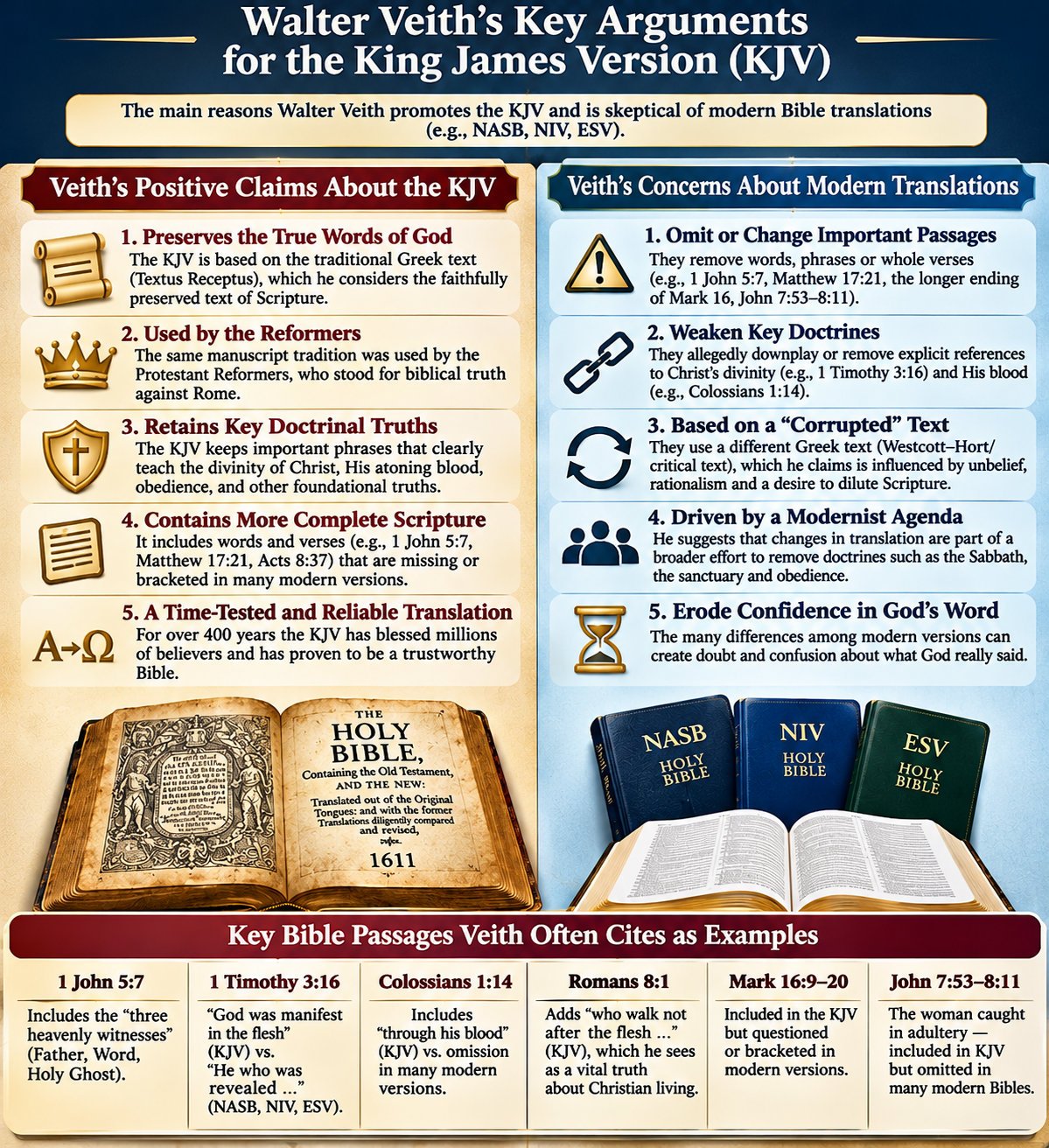
In his presentation Changing the Word, Walter Veith raises concerns about differences between the KJV and modern Bible translations.
His arguments deserve careful consideration.
1. Modern translations omit certain words and verses found in the KJV.
This is correct. Examples include 1 John 5:7, Matthew 17:21, Acts 8:37 and the longer wording of Romans 8:1.
However, the real question is whether these passages were part of the original inspired writings or were added during the copying process.
A longer reading is not necessarily more accurate.
2. Some modern translations appear to weaken references to Christ’s divinity and His blood.
For example, the KJV explicitly identifies God as manifested in the flesh in 1 Timothy 3:16.
It also includes the words “through his blood” in Colossians 1:14.
Modern translations often have shorter readings.
Nevertheless, this does not automatically mean that translators deliberately removed important Christian teachings. The differences frequently arise from the Greek manuscripts used.
3. The traditional Greek text was used by the Protestant Reformers.
The KJV New Testament largely follows the Textus Receptus, a printed Greek text associated with Erasmus, Stephanus and Beza.
The traditional Byzantine manuscript family is represented by a large number of surviving Greek manuscripts.
This is a legitimate consideration. However, manuscript quantity alone does not establish which reading is original.
4. Modern textual criticism should not be accepted uncritically.
I agree. Scholars can make mistakes, and their conclusions must be examined.
However, the same principle must apply to those defending the KJV.
The evidence should determine our conclusions, not our preference for particular scholars, preachers or theological traditions.
WHAT ADVENTIST BIBLICAL SCHOLARS SAY IN RESPONSE
Johannes Kovar — The Textus Receptus and Modern Bible Translations
Johannes Kovar directly addresses Walter Veith’s arguments in his study published by the Seventh-day Adventist Biblical Research Institute.
He explains that the Textus Receptus was compiled from a relatively small number of later Greek manuscripts.
Importantly, the Textus Receptus is not identical to the Majority Text. Some of its readings are not supported by the majority of Greek manuscripts, and certain readings originated through Erasmus’s use of Latin sources.
Kovar also challenges allegations concerning Westcott and Hort, pointing out that claims portraying them as spiritualists are not established by reliable historical evidence.
Most importantly, he demonstrates that modern translations do not systematically weaken the divinity of Christ. In some passages, they express it more clearly than the KJV.
READ: Were Westcott and Hort Spiritists, Anti-Trinitarians, and Enemies of the Bible?
Arthur Ferch — Which Version Can We Trust?
Arthur Ferch explains how biblical manuscripts were copied and how textual variations developed.
Copyists occasionally omitted words, repeated phrases, harmonised passages or combined different readings.
Therefore, a longer manuscript reading is not necessarily more original.
Ferch also explains that no fundamental Christian doctrine depends exclusively on a disputed textual reading.
Sakae Kubo and Walter F. Specht — So Many Versions?
These Adventist New Testament scholars examined the strengths and weaknesses of different Bible translations.
Their work illustrates why knowledge of the original languages and translation methods is essential.
A version may communicate the original meaning more accurately in one passage but less accurately in another.
ELLEN WHITE DID NOT BELIEVE WE MUST USE ONLY THE KJV
This is especially important for Seventh-day Adventists.
Ellen White used translations other than the KJV, including the English Revised Version and American Revised Version.
Johannes Kovar points out that The Ministry of Healing contains numerous quotations from these translations.
The Adventist Church also addressed the controversy in 1930 and 1931, allowing members freedom to use the KJV or American Revised Version.
In 1954, the church recognised two important reasons for producing new translations: discoveries that improve our understanding of the biblical text and changes in the English language.
The official Seventh-day Adventist document Methods of Bible Study specifically warns against building major doctrinal conclusions upon only one Bible translation.
This is a wise and balanced approach.
THE MOST IMPORTANT BIBLICAL COMPARISONS
The following examples illustrate significant differences in translation, manuscript evidence and theological interpretation.
The tables summarise the relevant wording rather than reproduce entire verses. NASB refers to the 2020 edition and NIV to the 2011 edition.
1. ROMANS 8:1 — NO CONDEMNATION IN CHRIST
| Translation | Important wording |
|---|---|
| KJV | No condemnation, followed by a qualification about walking according to the Spirit |
| NKJV | Retains the additional qualification |
| NASB | No condemnation for those in Christ Jesus |
| NIV | No condemnation for those in Christ Jesus |
| ESV | No condemnation for those in Christ Jesus |
Original Greek
The earliest and strongest manuscript evidence ends Romans 8:1 with en Christō Iēsou — “in Christ Jesus.”
The additional qualification in the KJV and NKJV appears in Romans 8:4, where it belongs.
It was probably introduced into verse 1 by copyists.
Evaluation
The NASB, NIV and ESV preserve the better-supported reading.
This is particularly important for understanding righteousness by faith.
Paul declares that those who are in Christ are no longer under condemnation. The additional KJV wording can make this assurance appear dependent upon successful obedience.
However, Romans 8:4 also teaches that the Spirit produces a transformed life. Obedience is the fruit of salvation, not its foundation.
Better-supported translations: NASB, NIV and ESV.
2. DANIEL 8:14 — CLEANSING, RESTORATION AND VINDICATION OF THE SANCTUARY
| Translation | Important wording |
|---|---|
| KJV | Sanctuary shall be cleansed |
| NKJV | Sanctuary shall be cleansed |
| NASB | Holy place will be properly restored |
| NIV | Sanctuary will be reconsecrated |
| AMP | Sanctuary will be cleansed and properly restored |
| Darby | Holy place shall be justified |
| NET | Sanctuary will be put right again |
Original Hebrew
The Hebrew verb nitsdaq (נִצְדַּק) comes from the root tsadaq, associated with righteousness, justice, justification and vindication.
Its meaning in this context concerns the sanctuary being put right or restored to its proper condition.
Evaluation
The KJV and NKJV emphasise cleansing, which connects with the Day of Atonement imagery in Leviticus 16.
The NASB highlights restoration, while Darby emphasises justification.
The NET Bible expresses the broader idea of putting the sanctuary right.
The Amplified Bible is particularly helpful because it combines cleansing and restoration.
However, its wording is an explanatory expansion rather than a literal translation of two separate Hebrew verbs.
For Adventists, the sanctuary’s cleansing and vindication are connected with God’s judgment and the final resolution of the controversy between good and evil.
Nevertheless, the application to 1844 must be established through the broader prophetic argument, not simply from the meaning of nitsdaq.
Most helpful explanatory translation: Amplified Bible.
3. HEBREWS 4:9 — DOES A SABBATH REST REMAIN?
| Translation | Important wording |
|---|---|
| KJV | There remains a rest |
| NKJV | There remains a rest |
| NASB | There remains a Sabbath rest |
| NIV | There remains a Sabbath-rest |
| ESV | There remains a Sabbath rest |
Original Greek
The word sabbatismos (σαββατισμός) has a specific association with Sabbath rest or Sabbath observance.
It differs from the more general word katapausis, used elsewhere in Hebrews 3–4.
Evaluation
The KJV and NKJV do not clearly communicate the Sabbath-related meaning of the original word.
The NASB, NIV and ESV make this connection more explicit.
This is important for Adventists, although the passage also discusses entering God’s rest through faith.
Clearer translations: NASB, NIV and ESV.
4. HEBREWS 9:12 — THE HOLY PLACE OR THE MOST HOLY PLACE?
| Translation | Important wording |
|---|---|
| KJV | Holy place |
| NKJV | Most Holy Place |
| NASB | Holy place |
| NIV | Most Holy Place |
| ESV | Holy places |
Original Greek
The expression ta hagia (τὰ ἅγια) can refer to holy places or the sanctuary.
It does not explicitly specify the second apartment.
Evaluation
The NKJV and NIV adopt the more specific interpretation “Most Holy Place.”
The KJV and NASB are less specific, while the ESV reflects the Greek plural.
For Adventist sanctuary theology, this distinction is important.
However, the Greek expression does not independently establish which apartment is intended. The argument of Hebrews 8–10 must be examined as a whole.
Least interpretive rendering: ESV.
5. 1 TIMOTHY 3:16 — WAS GOD MANIFESTED IN THE FLESH?
| Translation | Important wording |
|---|---|
| KJV | God was manifest in the flesh |
| NKJV | God was manifested in the flesh |
| NASB | He who was revealed in the flesh |
| NIV | He appeared in the flesh |
| ESV | He was manifested in the flesh |
Original Greek
The traditional text reads Theos (God), while the modern critical text reads hos (who).
The two forms could be confused because of the way sacred names were abbreviated in Greek manuscripts.
Evaluation
The KJV and NKJV make Christ’s divinity more explicit.
However, the earlier manuscript evidence generally favours the reading underlying the NASB, NIV and ESV.
Modern translations do not deny Christ’s divinity. It is clearly taught elsewhere, including John 1:1 and John 20:28.
Better-supported textual reading: NASB, NIV and ESV.
6. 2 PETER 1:1 — WHERE MODERN TRANSLATIONS MAKE CHRIST’S DIVINITY CLEARER
| Translation | Important wording |
|---|---|
| KJV | God and our Saviour Jesus Christ |
| NKJV | Our God and Savior Jesus Christ |
| NASB | Our God and Savior, Jesus Christ |
| NIV | Our God and Savior Jesus Christ |
| ESV | Our God and Savior Jesus Christ |
Original Greek
The expression tou theou hēmōn kai sōtēros Iēsou Christou identifies Jesus Christ as both God and Saviour.
The grammatical construction strongly favours understanding the two titles as referring to the same person.
Evaluation
This is one of the strongest arguments against the claim that modern translations systematically weaken Christ’s divinity.
The KJV wording can be misunderstood as referring to two separate persons.
The NKJV, NASB, NIV and ESV communicate the Greek construction more clearly.
Johannes Kovar specifically identifies this passage as evidence against the accusation that modern Bible translations deliberately remove references to Christ’s divinity.
Clearer translations: NKJV, NASB, NIV and ESV.
7. COLOSSIANS 1:14 — REDEMPTION THROUGH CHRIST’S BLOOD
| Translation | Important wording |
|---|---|
| KJV | Includes “through his blood” |
| NKJV | Includes “through His blood” |
| NASB | Omits those words |
| NIV | Omits those words |
| ESV | Omits those words |
Original Greek
The longer traditional reading includes dia tou haimatos autou, meaning “through His blood.”
The shorter reading is supported by important early manuscript evidence.
Evaluation
The KJV and NKJV explicitly emphasise Christ’s blood.
However, the shorter reading is generally considered better supported.
Furthermore, Ephesians 1:7 clearly teaches redemption through Christ’s blood, and Colossians 1:20 also refers to His blood. Therefore, the shorter reading does not remove this doctrine from Scripture.
Better-supported textual reading: NASB, NIV and ESV.
8. 1 JOHN 5:7–8 — THE THREE HEAVENLY WITNESSES
| Translation | Important wording |
|---|---|
| KJV | Includes Father, Word and Holy Ghost as three who are one |
| NKJV | Retains the longer reading |
| NASB | Spirit, water and blood |
| NIV | Spirit, water and blood |
| ESV | Spirit, water and blood |
Original Greek
The longer passage is known as the Comma Johanneum.
It is absent from the early Greek manuscript tradition and is generally regarded as a later addition.
Evaluation
The NASB, NIV and ESV are substantially better supported.
Although the longer KJV reading appears to support the Trinity explicitly, doctrines should not be established using passages that are unlikely to have been part of the original text.
Better-supported translations: NASB, NIV and ESV.
9. JOHN 5:3–4 — DID AN ANGEL STIR THE WATER AT BETHESDA?
| Translation | Important wording |
|---|---|
| KJV | Describes an angel stirring the water and the first person entering being healed |
| NKJV | Retains the explanation |
| NASB | Omits the explanation from the main text |
| NIV | Omits the explanation from the main text |
| ESV | Omits the explanation from the main text |
Original Greek
The angelic explanation is absent from important early Greek manuscripts.
It appears to have been added to explain the sick man’s statement in John 5:7 about the movement of the water.
Evaluation
This is one of the most interesting examples because Ellen White’s explanation agrees with the view that the healing power attributed to the water was a popular belief.
In The Desire of Ages, page 201, she explains that people believed the movement of the water resulted from supernatural power.
She does not endorse the idea that God healed only the first person able to enter the pool.
Johannes Kovar specifically discusses this passage in his response to KJV-only arguments. The longer reading could suggest that God favoured the strongest and quickest sufferers while leaving the weakest without help.
The shorter reading avoids presenting that belief as the narrator’s explanation of divine activity.
Better-supported translations: NASB, NIV and ESV.
10. REVELATION 22:14 — KEEPING THE COMMANDMENTS OR WASHING THE ROBES?
| Translation | Important wording |
|---|---|
| KJV | Do His commandments |
| NKJV | Do His commandments |
| NASB | Wash their robes |
| NIV | Wash their robes |
| ESV | Wash their robes |
Original Greek
Two readings survive:
Poiountes tas entolas autou — doing His commandments.
Plynontes tas stolas autōn — washing their robes.
Evaluation
The KJV and NKJV emphasise obedience.
The NASB, NIV and ESV emphasise cleansing.
Modern critical editions generally favour the washing-of-robes reading.
The latter also corresponds with Revelation 7:14.
Both obedience and cleansing are important biblical teachings. However, our theological preference should not determine which Greek reading we accept.
Generally preferred textual reading: NASB, NIV and ESV.
11. REVELATION 22:19 — THE BOOK OF LIFE OR THE TREE OF LIFE?
| Translation | Important wording |
|---|---|
| KJV | Book of life |
| NKJV | Book of Life |
| NASB | Tree of life |
| NIV | Tree of life |
| ESV | Tree of life |
Original Greek
The Greek manuscript tradition overwhelmingly supports xylon tēs zōēs, meaning “tree of life.”
The “book of life” reading entered the Textus Receptus through Erasmus’s dependence on a Latin source when reconstructing the final verses of Revelation.
Evaluation
This is one of the clearest examples demonstrating that the Textus Receptus is not identical to the original Greek text.
The “book of life” reading lacks the early Greek support available for “tree of life.”
The NASB, NIV and ESV therefore preserve the better-supported wording.
Better-supported translations: NASB, NIV and ESV.
12. MARK 16:9–20 — WAS THE LONGER ENDING PART OF MARK’S ORIGINAL GOSPEL?
| Translation | Treatment |
|---|---|
| KJV | Includes verses 9–20 without a textual warning |
| NKJV | Includes the verses with manuscript notes |
| NASB | Includes the passage with a textual warning |
| NIV | Includes the passage with a warning about early manuscripts |
| ESV | Includes the passage with a textual warning |
Original manuscript evidence
The two important fourth-century manuscripts Codex Sinaiticus and Codex Vaticanus end Mark at 16:8.
However, the longer ending is found in most later Greek manuscripts and is known to early Christian writers, including Irenaeus in the second century.
Evaluation
This is a genuine and historically important textual dispute.
Many scholars conclude that verses 9–20 were not part of Mark’s original ending because of manuscript evidence, differences in vocabulary and style, and the existence of alternative endings.
Nevertheless, the early attestation of the longer ending means the question should not be presented as though the passage appeared only in medieval manuscripts.
The most responsible approach is to retain awareness of the passage while informing readers about its disputed textual status.
Importantly, teachings concerning resurrection, evangelism and Christ’s ascension are clearly established elsewhere.
The references to handling snakes and drinking poison should not become the basis for dangerous religious practices.
Best editorial approach: Include the passage with clear textual notes.
13. JOHN 7:53–8:11 — THE WOMAN CAUGHT IN ADULTERY
| Translation | Treatment |
|---|---|
| KJV | Includes the account without a textual warning |
| NKJV | Includes the account with manuscript notes |
| NASB | Includes the account with a textual warning |
| NIV | Includes the account with a warning |
| ESV | Includes the account with a textual warning |
Original manuscript evidence
The account is absent from important early Greek manuscripts of John.
In other manuscripts, it appears in different locations, including elsewhere in John and in Luke.
However, the story has an ancient history in Christian tradition.
Evaluation
The evidence suggests that the account was probably not originally located in John’s Gospel at this point.
Nevertheless, many scholars consider it possible that the story preserves an authentic tradition about Jesus.
The account beautifully illustrates Christ’s mercy and His opposition to sin.
Ellen White also discusses this event in The Desire of Ages.
The appropriate response is neither to dismiss the story automatically nor to ignore the manuscript evidence.
Best editorial approach: Preserve the account with an explanation of its textual history.
14. LUKE 23:43 — DID THE THIEF GO TO PARADISE THAT SAME DAY?
| Translation | Important wording |
|---|---|
| KJV | Today you will be with Me in Paradise |
| NKJV | Same interpretation |
| NASB | Same interpretation |
| NIV | Same interpretation |
| ESV | Same interpretation |
Original Greek
The Greek contains sēmeron, meaning “today.”
The ancient text did not contain modern English punctuation.
Two possible interpretations are:
“Truly I tell you, today you will be with Me in Paradise.”
Or:
“Truly I tell you today, you will be with Me in Paradise.”
Evaluation
All five translations adopt the first interpretation.
This is the more conventional and linguistically natural punctuation, but the alternative is grammatically possible.
For Adventists, the passage is important because of the biblical teaching concerning death and resurrection.
John 20:17, where Jesus says He has not yet ascended to His Father, is relevant to the discussion.
However, punctuation alone cannot establish the complete biblical teaching about the state of the dead.
Conclusion: This is primarily an interpretive question rather than a difference between the five translations.
15. ACTS 12:4 — EASTER OR PASSOVER?
| Translation | Important wording |
|---|---|
| KJV | Easter |
| NKJV | Passover |
| NASB | Passover |
| NIV | Passover |
| ESV | Passover |
Original Greek
The word pascha (πάσχα) refers to the Jewish Passover in this context.
Evaluation
For modern readers, “Easter” is misleading because it suggests a later Christian festival.
The NKJV, NASB, NIV and ESV communicate the meaning more clearly.
Better modern translations: NKJV, NASB, NIV and ESV.
WHAT ABOUT OTHER IMPORTANT PASSAGES?
Several additional passages deserve attention, although they are not necessary for the main comparison tables.
Acts 8:37: The KJV and NKJV include the Ethiopian official’s confession of faith before baptism. Most modern translations omit it from the main text because of manuscript evidence. The importance of faith before baptism is established elsewhere.
Matthew 17:21: The KJV and NKJV include a statement concerning prayer and fasting. Modern editions generally omit or bracket it because of textual evidence. Prayer remains clearly taught in the parallel account.
John 6:47: The KJV explicitly includes believing “on me,” while modern translations generally have the shorter reading. However, the surrounding context repeatedly identifies Jesus as the object of saving faith.
1 Corinthians 15:47: The KJV and NKJV include the explicit title “Lord” in reference to the second man from heaven. The modern critical text lacks that additional title. Nevertheless, Christ’s lordship is clearly taught throughout the New Testament.
Hebrews 10:23: The KJV refers to the profession of “faith,” whereas the Greek word elpis means “hope.” The NKJV, NASB, NIV and ESV correctly translate it as hope. This is a straightforward example of a modern rendering more closely reflecting the Greek word.
2 Timothy 2:15: The KJV begins with “Study to shew thyself approved.” The Greek verb spoudazō means to be diligent or make every effort. The modern meaning of “study” can mislead readers into thinking the verse specifically commands academic study rather than diligent faithfulness.
These examples further demonstrate why the KJV should not be treated as a flawless translation.
THE STRONGEST ARGUMENTS AGAINST KJV-ONLY TEACHING
After examining the manuscript evidence and the studies of Adventist biblical scholars, several conclusions are especially important.
First, the KJV translators did not possess all the manuscript evidence available today.
Since 1611, many ancient manuscripts have been discovered, including important New Testament papyri and the Dead Sea Scrolls.
These discoveries have improved our knowledge of the biblical text.
Second, the Textus Receptus is not identical to the Majority Text.
It was compiled and revised by scholars using a limited selection of manuscripts.
Some readings, particularly in Revelation, were influenced by Latin sources.
Therefore, it cannot reasonably be described as a perfectly preserved Greek text without textual problems.
Third, older manuscripts are not automatically better, but neither are later manuscripts.
The age, geographical distribution, textual relationships and internal characteristics of manuscripts must all be considered.
A thousand manuscripts descended from a common textual ancestor do not necessarily provide a thousand independent witnesses.
Fourth, modern translations do not systematically remove Christ’s divinity.
Second Peter 1:1 provides a particularly strong counterexample.
Modern translations sometimes communicate the divinity of Christ more clearly than the KJV.
Fifth, no fundamental Christian doctrine depends exclusively on a disputed textual reading.
The divinity of Christ, His atoning death, resurrection, salvation by grace and His second coming are supported by numerous passages.
Textual variations should encourage careful study, not destroy our confidence in Scripture.
Sixth, the KJV contains genuine translation problems.
Acts 12:4 and Hebrews 10:23 are clear examples.
Its archaic vocabulary also creates unnecessary difficulties for modern readers.
Seventh, Ellen White did not limit herself to the KJV.
She used other translations and recognised the human element in the transmission of Scripture.
Eighth, the Seventh-day Adventist Church has never required its members to use only the KJV.
Its official guidance encourages faithful translations, examination of the original languages and caution against building doctrines on one English version.
WHY COMPARING BIBLE TRANSLATIONS IS SO IMPORTANT
Personally, I prefer the NKJV because it is relatively literal, preserves familiar biblical expressions and is easier to understand than the KJV.
However, I do not believe it is perfect.
When studying important passages, I compare it with the NASB, NIV, ESV and occasionally other translations such as the Amplified Bible.
I also consult Hebrew and Greek dictionaries and lexicons.
Nevertheless, knowing the possible meanings of a word is not enough. The correct meaning must be determined by grammar, historical context and the way the biblical writer uses the word.
Commentaries can also be helpful, particularly when scholars representing different theological traditions discuss the same passage.
This approach allows us to recognise our assumptions and consider interpretations we might otherwise overlook.
I believe the same principle applies to respected Christian teachers. We can appreciate their ministry without accepting every conclusion they reach.
CONCLUSION — THE BIBLE, NOT A PARTICULAR TRANSLATION, MUST BE OUR AUTHORITY
I greatly appreciate Walter Veith’s dedication to defending biblical truth. His concerns about the preservation of Scripture should encourage Christians to examine Bible translations carefully.
However, I cannot agree that the KJV should be regarded as the only trustworthy English Bible.
The evidence demonstrates that the KJV contains genuine translation problems and some manuscript readings that are less reliable than those preserved in modern translations.
At the same time, modern translations are not perfect either. They sometimes adopt interpretations that may obscure important biblical concepts.
Therefore, rather than defending one translation unconditionally, we should seek to understand what the inspired biblical writers originally intended to communicate.
This means comparing translations, examining the original Hebrew and Greek, studying the context and consulting reliable scholarly resources.
Ellen White’s example and the Seventh-day Adventist Church’s official guidance support this balanced approach.
The Bible was originally written in Hebrew, Aramaic and Greek, not in the English of 1611. No English translation should be treated as infallible.
Our purpose in studying Scripture should never be to prove that our favourite translation is always correct, but to discover the truth God has revealed through His Word.
RECOMMENDED SOURCES
1. Johannes Kovar — The Textus Receptus and Modern Bible Translations
https://adventistbiblicalresearch.org/articles/the-textus-receptus-and-modern-bible-translations/
A direct Adventist scholarly response to Walter Veith, examining the Textus Receptus, manuscript evidence, Christological passages and Ellen White’s use of translations.
2. Arthur Ferch — Which Version Can We Trust?
https://adventistbiblicalresearch.org/articles/which-version-can-we-trust/
A comprehensive four-part study of textual transmission, modern translations and the historical Adventist position.
3. Sakae Kubo and Walter F. Specht — So Many Versions?
A scholarly book examining twentieth-century English Bible translations and the principles of translation.
4. Seventh-day Adventist Church — Methods of Bible Study
https://adventistbiblicalresearch.org/en/articles/methods-of-bible-study/
Official guidance on biblical interpretation, original languages, translations and doctrinal study.
5. Walter Veith — Changing the Word
Amazing Discoveries, Total Onslaught, lecture 214.
Walter Veith’s presentation defending the traditional biblical text and questioning modern Bible translations.
6. NET Bible — Daniel 8:14 and translation notes
https://classic.net.bible.org/passage.php?passage=Dan+8%3A14
Provides useful Hebrew translation notes explaining the meanings “vindicated,” “justified” and “put right.”