
Unclean Foods: Why Did God Forbid Them?
Slawomir Gromadzki
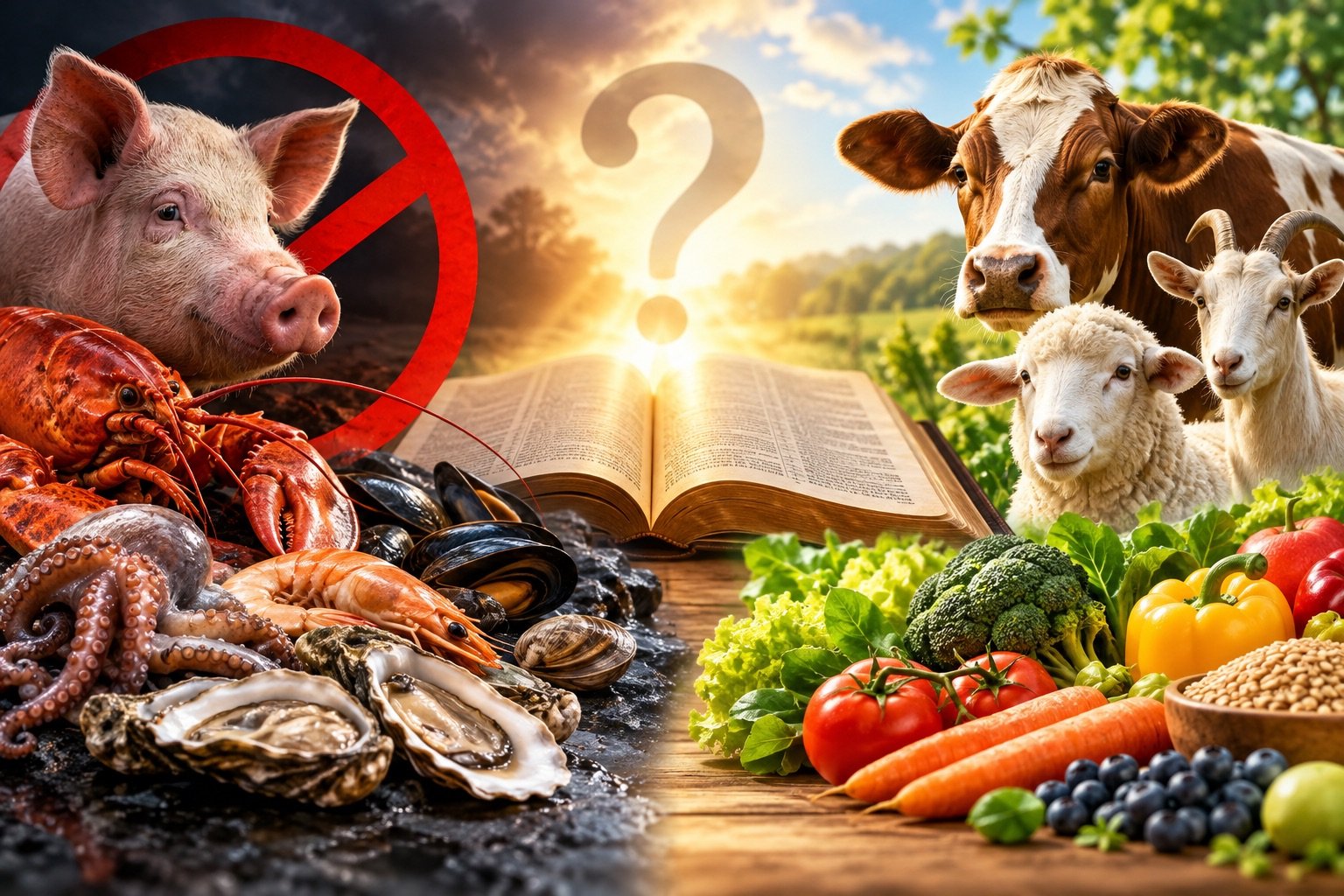
Many Christians believe that the distinction between clean and unclean animals was given only for the Jews, or that it ended at the cross. But were pigs, shellfish and other animals, declared unclean, made suitable for food? When we examine the Bible together with what we now know about animal physiology and foodborne disease, there are strong reasons to take God’s instructions seriously.
CLEAN AND UNCLEAN ANIMALS EXISTED BEFORE THE JEWS
The distinction between clean and unclean animals was not originally given only to the Jews—it was known to humanity long before the Jewish nation even existed. One of the clearest proofs is found in the account of Noah, centuries before Moses, Mount Sinai, or the nation of Israel. God told Noah: “You shall take with you seven each of every clean animal… two each of animals that are unclean.” Genesis 7:2
Noah was not a Jew, and there was no Jewish nation at that time. Yet God clearly distinguished between clean and unclean animals, and Noah already understood what these categories meant. Therefore, the distinction did not originate with the Jewish ceremonial laws given at Mount Sinai. It existed from the earliest history of humanity and was known before Israel existed.
GOD SPECIFICALLY SAID NOT TO EAT THEIR FLESH
Leviticus 11 explains which animals were suitable for food. Clean land animals must both divide the hoof and chew the cud. The pig meets only one condition: “And the swine, though it divides the hoof… yet does not chew the cud, is unclean to you. Their flesh you shall not eat.” Leviticus 11:7–8.
Notice the direct instruction: “Their flesh you shall not eat.” This is clearly about food, not merely ceremonial contact.
For aquatic creatures, God gave another simple rule: “Whatever in the water has fins and scales… that you may eat.” Leviticus 11:9. Other aquatic creatures were classified as unclean, including eels, shellfish and crustaceans such as crabs, lobsters, prawns and shrimps, as well as molluscs such as oysters, mussels, clams, scallops, squid and octopus (Leviticus 11:9–12).
GOD CONNECTED THESE INSTRUCTIONS WITH HOLINESS
At the conclusion of Leviticus 11, God says: “You shall therefore consecrate yourselves, and you shall be holy; for I am holy.” Leviticus 11:44.
Peter later applies the same principle to Christians: “As He who called you is holy, you also be holy in all your conduct, because it is written, ‘Be holy, for I am holy.’” 1 Peter 1:15–16.
Our bodies still matter to God. Paul writes: “Your body is the temple of the Holy Spirit… therefore glorify God in your body.” 1 Corinthians 6:19–20. He also says: “Whether you eat or drink, or whatever you do, do all to the glory of God.” 1 Corinthians 10:31.
UNCLEAN FOODS WERE FORBIDDEN FOR HEALTH REASONS
Ellen White gives one of the clearest explanations: “The distinction between articles of food as clean and unclean was not a merely ceremonial and arbitrary regulation, but was based upon sanitary principles.” — Patriarchs and Prophets, p. 562.
This is important. According to Ellen White, these were not meaningless ceremonial restrictions. There were health and sanitary principles behind them.
Concerning pork she wrote: “God did not prohibit the Hebrews from eating swine’s flesh merely to show His authority, but because it was not a proper article of food for man.” — Counsels on Diet and Foods, p. 392.
She also stated: “God never designed the swine to be eaten under any circumstances.” — Spiritual Gifts, vol. 4a, p. 124.
And concerning other prohibited animals she wrote that they “were forbidden to be eaten by the Israelites, because they were not the best articles of food.” — Spiritual Gifts, vol. 4a, p. 124.
She described pigs as scavengers and also warned about parasites associated with their flesh. Her main point was simple: God’s distinction was protective rather than arbitrary.
PIGS CANNOT EFFECTIVELY SWEAT THROUGH THEIR SKIN
There is an interesting physiological fact about pigs which is sometimes dismissed as a myth but is substantially true: pigs cannot effectively regulate their body temperature by sweating through their skin.
Scientific literature reports that pigs have a very low density of sweat glands—around 30 per square centimetre compared with approximately 800–2,000 per square centimetre reported in cattle. More importantly, the glands pigs possess respond poorly to heat and make little contribution to cooling. Experimental research has even reported “no evidence of thermal sweating.”
This is why pigs depend heavily upon shade, water, mud, panting and behavioural changes to prevent overheating. Their substantial layer of subcutaneous fat can make heat dissipation even more difficult. (pmc.ncbi.nlm.nih.gov)
Because pigs have a very limited ability to sweat through their skin, this particular route by which the body can excrete small amounts of toxic substances is greatly reduced. Their ability to eliminate toxins through perspiration is therefore much lower than in animals that sweat effectively.
PIGS ARE SCAVENGERS THAT EAT EXCREMENT
Pigs are highly opportunistic omnivores with a strong natural instinct to scavenge. One particularly unpleasant but well-documented behaviour is coprophagy—the eating of faeces. Scientific studies confirm this behaviour in pigs and piglets. Remarkably, a United Nations Food and Agriculture Organisation review reported that free-roaming pigs may consume poultry and cattle manure even when they are otherwise well fed.
This agrees with Ellen White’s striking description: “Swine are scavengers.” — The Ministry of Healing, pp. 313–314.
Prof. Walter Veith also draws attention to the feeding habits, digestive physiology and natural functions of animals when discussing the distinction between clean and unclean foods. Unlike clean ruminants such as cattle, sheep and goats, pigs do not chew the cud and have a much simpler monogastric digestive system. Their opportunistic feeding behaviour can include material that humans would certainly never regard as food.
WALTER VEITH: WHY THE BIOLOGY OF CLEAN AND UNCLEAN ANIMALS MATTERS
Prof. Walter Veith points out that the pig differs significantly from the clean animals described in Leviticus 11. Unlike cattle, sheep and goats, the pig does not chew the cud and has a much simpler digestive system. He argues that the differences in digestion, feeding habits, physiology and natural function of clean and unclean animals help explain why God’s distinction was designed to protect human health.
Clean land animals described in Leviticus 11 must both divide the hoof and chew the cud. Familiar examples such as cattle, sheep and goats are ruminants. Their specialised digestive systems repeatedly process plant material through microbial fermentation before nutrients are absorbed.
The pig is different. Although it has a divided hoof, it does not chew the cud and has a monogastric digestive system. Veith argues that these differences, together with the feeding habits and biological functions of various unclean animals, show that God’s classification was not arbitrary.
Veith also emphasises that many animals classified as unclean perform valuable functions in nature. Some are scavengers, predators, bottom feeders or filter feeders. They may be extremely useful in their natural environment without being suitable food for human beings.
PORK CAN CARRY IMPORTANT INFECTIONS
There are also well-documented health risks associated with pork. UK Government health guidance states that hepatitis E in Britain has been associated with eating undercooked meat, especially pork and pork products. (gov.uk)
Pork is also an important source of Yersinia infection when contaminated meat is eaten raw or insufficiently cooked. The US Centers for Disease Control and Prevention specifically advises extra care when preparing pork. (cdc.gov)
Pork and wild boar can also transmit Trichinella parasites when contaminated meat is consumed raw or undercooked. Modern farming, inspection and proper cooking have greatly reduced this danger in commercially produced pork in many countries, but the biological risk is genuine. (cdc.gov)
WHAT ABOUT SHELLFISH AND OTHER UNCLEAN SEA CREATURES?
Leviticus 11 says: “Whatever in the water has fins and scales… that you may eat.” Leviticus 11:9. Creatures that did not meet these criteria were excluded.
This is interesting when we consider how some shellfish live and feed. Bivalves such as oysters, mussels and clams are filter feeders. They continuously filter large quantities of surrounding water and can therefore concentrate microorganisms and naturally occurring marine toxins.
This is why shellfish poisoning and infections associated with contaminated shellfish remain recognised public-health problems today. Cooking can destroy many microorganisms, but some marine biotoxins are heat-stable and are not reliably removed by normal cooking.
MANY UNCLEAN ANIMALS HAVE IMPORTANT JOBS – JUST NOT NECESSARILY ON OUR PLATES
A scavenger is not a “bad” animal. Neither is a bottom feeder or filter feeder. These creatures can perform essential functions in ecosystems.
The question is whether everything useful in nature was intended to become human food.
Ellen White wrote concerning pigs: “Swine are scavengers, and this is the only use they were intended to serve.” — The Ministry of Healing, pp. 313–314.
God created vultures, worms, shellfish, predators and countless other organisms for important purposes. Their usefulness does not mean that humans should eat all of them.
DID JESUS DECLARE UNCLEAN ANIMALS CLEAN IN MARK 7?
Mark 7 is probably the most common New Testament argument used against Leviticus 11. But look carefully at the context.
The controversy begins because Jesus’ disciples ate “with defiled, that is, with unwashed hands.” Mark 7:2. The Pharisees therefore asked why His disciples ate “with unwashed hands.” Mark 7:5.
Jesus was addressing human traditions concerning ritual defilement and explaining that moral defilement comes from the heart. The discussion was not about changing pigs, shellfish and other unclean creatures into clean animals.
PETER STILL REFUSED UNCLEAN FOOD AFTER THE CROSS
Acts 10 provides one of the strongest New Testament arguments. Years after Christ’s death and resurrection, Peter saw a vision containing different animals and heard: “Rise, Peter; kill and eat.” Acts 10:13.
Peter immediately answered: “Not so, Lord! For I have never eaten anything common or unclean.” Acts 10:14.
Think about what this means. Peter had spent years with Jesus. He had personally heard His teaching, witnessed His death and seen Him after His resurrection. Yet years later Peter could truthfully say that he had NEVER eaten anything unclean.
If Jesus had taught His disciples in Mark 7 that pigs and other unclean animals had become food, Peter clearly did not understand His words that way.
PETER HIMSELF EXPLAINS WHAT THE VISION MEANT
We do not have to guess what Acts 10 means because Peter explains it himself: “God has shown me that I should not call any MAN common or unclean.” Acts 10:28.
Peter does NOT say: “God has shown me that pigs are now clean.”
He says God showed him not to call any PERSON unclean.
The vision prepared Peter to enter the home of Cornelius and understand that Gentiles were also accepted by God. Using Peter’s vision primarily as permission to eat pork ignores Peter’s own explanation.
WHAT ABOUT ROMANS 14?
Romans 14:2 says: “For one believes he may eat all things, but he who is weak eats only vegetables.”
Notice the contrast. Paul does not contrast CLEAN MEAT with UNCLEAN MEAT. He contrasts eating with abstaining/eating vegetables.
The chapter concerns disputes among believers about food, days and conscience. Nowhere does Paul announce that pigs, shellfish or other animals prohibited in Leviticus 11 have become clean.
Therefore Romans 14 should not be made to say something that Paul never actually says.
WHAT ABOUT 1 TIMOTHY 4:4 – “EVERY CREATURE OF GOD IS GOOD”?
Paul writes: “For every creature of God is good, and nothing is to be refused if it is received with thanksgiving.” 1 Timothy 4:4.
But immediately before this Paul describes “foods which God created to be received with thanksgiving.” 1 Timothy 4:3.
The question therefore is: Which creatures did God designate as food?
Scripture had already distinguished animals suitable for food from those that were not.
Giving thanks cannot transform everything in nature into food. Prayer over a poisonous mushroom would not make it edible. Thanksgiving does not erase biological distinctions.
ISAIAH 66 CREATES A SERIOUS PROBLEM FOR THE “IT ENDED AT THE CROSS” ARGUMENT
Isaiah describes the LORD coming “with fire” in judgment. Isaiah 66:15–16. In that context, he refers negatively to people “eating swine’s flesh and the abomination and the mouse.” Isaiah 66:17.
Whatever interpretation is given to every prophetic detail, this is difficult to reconcile with the idea that pork was merely a temporary Jewish ceremonial problem with no later significance.
DID THE CROSS CHANGE THE NATURE OF A PIG?
Christ’s sacrifice fulfilled the sacrificial ceremonies that pointed forward to Him. But did His death change the anatomy of a pig? Did pigs suddenly begin chewing the cud? Did their digestive physiology change? Did filter feeders and scavengers suddenly acquire completely different biological functions?
Nothing in the New Testament says that they did.
More importantly, there is no clear New Testament declaration saying: “The animals God called unclean are now clean and may be eaten.”
Instead, years after the cross, Peter still said: “I have never eaten anything common or unclean.” Acts 10:14, NKJV.
GOD’S ORIGINAL DIET WAS EVEN BETTER
There is an even bigger biblical picture. God’s original diet for humanity was plant-based: “See, I have given you every herb that yields seed… and every tree whose fruit yields seed; to you it shall be for food.” Genesis 1:29.
For Christians seeking good health, therefore, the question should not merely be: “Am I allowed to eat this?”
A better question is: “Is this among the best foods for the body God has given me?”
THE EVIDENCE FOR A CHRISTIAN IS STRONG
The clean/unclean distinction existed before Israel (Genesis 7:2). God specifically said not to eat the flesh of unclean animals (Leviticus 11:7–8). He connected these instructions with holiness (Leviticus 11:44–45). Ellen White said the distinction was not merely ceremonial but was “based upon sanitary principles.” Modern science confirms interesting physiological differences between animal groups and demonstrates genuine health hazards associated with pork and some shellfish.
Jesus’ discussion in Mark 7 concerned ritual defilement and unwashed hands. After the cross, Peter still refused unclean animals (Acts 10:14), and Peter himself explained that his vision concerned PEOPLE (Acts 10:28). Romans 14 never says unclean animals became clean. First Timothy speaks about foods “which God created to be received.” And Isaiah 66 still portrays eating swine’s flesh negatively in a judgment setting.
Modern science cannot tell us every reason why God classified each animal as He did, and we should not manufacture scientific explanations where evidence is lacking. But neither should Christians dismiss God’s instructions simply because we do not yet understand every reason behind them.
Ellen White summarised the principle clearly: “The distinction between articles of food as clean and unclean was not a merely ceremonial and arbitrary regulation, but was based upon sanitary principles.” — Patriarchs and Prophets, p. 562.
God created our bodies. He also created the animals. He knows both better than we do. If He identified certain creatures as unsuitable for human food, and the New Testament nowhere clearly reverses that distinction, we have good reason to trust His wisdom.