
Introduction: Why the Incarnation of Christ Is So Important
Because the incarnation of the Son of God is closely connected with the truth as it is in Christ (the gospel) and formed the foundation of the Minneapolis message, this subject should be the focus of our careful and thorough study.
Knowing how much controversy this subject has caused, and continues to cause, within Christianity, I have made a special effort to prepare for it very carefully and thoroughly by studying the Holy Scriptures, the writings of the Spirit of Prophecy, and the commentaries of respected Adventist and Protestant theologians.
Although this study is relatively short, a careful examination of all the statements, commentaries, and comparisons it contains should provide a clear understanding of the kind of human nature the Son of God actually assumed.
However, for this to happen, we must first put aside all prejudices, approach the subject sincerely, and carefully examine and become thoroughly familiar with all the information presented in this study.
I kindly ask everyone who has not carefully studied this entire presentation from beginning to end to refrain from making any comments, because otherwise they may find themselves expressing opinions about something they have not sufficiently understood.
When we carefully read the Word of God, we notice that the humanity of Jesus Christ plays a crucial role in the plan of salvation for fallen humanity. It was precisely by assuming human nature that the Son of God obtained the right to justify us and to become our representative in the struggle against sin and death.
According to Ellen White, “The humanity of Christ is everything to us.” It is therefore a mistake to claim that this subject has no particular value for us or that it does not matter what kind of nature Christ assumed.
This subject is of the utmost importance and is of priceless value in understanding human salvation:
“If we would study a deep subject, let us fix our minds on the most wonderful thing that ever took place in earth or heaven—the incarnation of the Son of God… The humanity of Christ is everything to us. It is the golden chain that binds our souls to Christ, and through Christ to God. This is to be our study…
We must come to the study of this subject with the humility of a learner, with a contrite heart. And the study of the incarnation of Christ is a fruitful field, which will repay the searcher who digs deep for hidden truth.” (Ellen G. White, SDA Bible Commentary, vol. 7, pp. 904–905, commentary on Philippians 2:5–8)
One of the most distinguished Protestant theologians, the Anglican bishop J. A. T. Robinson, wrote about the importance of Christ’s humanity for a proper understanding of the plan of salvation:
“The Son of God identified Himself completely with human flesh in its fallen condition. We must emphasize these words particularly strongly, because Christian theology has been extremely reluctant to accept the bold language used by Paul…
The traditional view, both Catholic and Protestant, maintains that Christ assumed a sinless human nature… Yet the Bible clearly presents His humanity as affected by all the consequences of the Fall.” (J. A. T. Robinson, The Body: A Study in Pauline Theology, 1952, pp. 37–38)
Another distinguished theologian, Karl Barth, held a similar view:
“Jesus was not a sinful man, but His situation—both inwardly and outwardly—was exactly the same as that in which sinful man finds himself… Christ voluntarily identified Himself with us and entered into the relationship with our condemned existence that was necessary for our salvation.
The nature which God assumed in Christ was identical with our fallen nature…
We must not call into question His complete solidarity with us and thereby distance Him from us.” (Karl Barth, Church Dogmatics, vol. I/2, pp. 152–153)

Recommended Further Reading
The incarnation of Christ is closely connected with several other essential biblical truths that help us understand the gospel and God’s wonderful plan of salvation. To gain a deeper understanding of why the Son of God took upon Himself our fallen human nature and what He accomplished for the entire human race, I strongly recommend reading my other articles on the following subjects:
- The “In Christ” Motif
- Universal Legal Justification (ULJ) – Supporters and Opponents
- The Cross of Christ and the Love of God
These subjects are inseparably connected. Studying them together will help us gain a clearer and more complete understanding of the gospel, the salvation God accomplished for humanity in Christ, and above all, the immeasurable love of God revealed through the incarnation, life, suffering, and sacrifice of His beloved Son.
What Does the Word of God Say About the Incarnation of the Son of God?
Hebrews 2:16
“For indeed He does not give aid to angels, but He does give aid to the seed of Abraham.”
Why did Paul write here that Christ gives aid “not to angels, but to the seed of Abraham”?
What is the difference between angels and the seed of Abraham?
Angels are sinless, whereas the descendants of Abraham are sinful and possess fallen natures.
What Paul meant when he wrote that Christ gives aid “not to angels, but to the seed of Abraham” is explained by Paul himself in the following verse, verse 17:
“Therefore, in all things He had to be made like His brethren” (that is, the “seed of Abraham”), “that He might be a merciful and faithful High Priest in things pertaining to God, to make propitiation for the sins of the people.” (Hebrews 2:17)
This passage clearly and unequivocally states that the Son of God had to be made like His “brethren” in “all things”—not like the angels, who are sinless. And His “brethren,” that is, the “seed of Abraham,” possessed sinful human nature.
Similarly, He could not have been made like Adam before the Fall, because Adam, like the angels, was free from fallen human nature.
Hebrews 2:18
“For in that He Himself has suffered, being tempted, He is able to aid those who are tempted.”
Since the Bible says that Christ “suffered, being tempted,” we must answer the question: What caused Christ to suffer when He resisted temptation?
1 Peter 4:1
“Therefore, since Christ suffered for us in the flesh, arm yourselves also with the same mind, for he who has suffered in the flesh has ceased from sin.”
It clearly follows from this that the reason Jesus suffered when resisting temptation was the “flesh,” that is, fallen human nature.
Another passage concerning the incarnation of the Son of God, which is very frequently quoted, is found in Hebrews 4:14–16:
“Seeing then that we have a great High Priest who has passed through the heavens, Jesus the Son of God, let us hold fast our confession.” (Hebrews 4:14)
What is this confession that we are to “hold fast”?
Verse 15:
“For we do not have a High Priest who cannot sympathize with our weaknesses, but was in all points tempted as we are, yet without sin.” (Hebrews 4:15)
Because Jesus Christ united Himself with our nature, He “was in all points tempted as we are,” with one difference: in His mind, He never yielded to temptation in the slightest degree.
Romans 8:3 — What Does “In the Likeness of Sinful Flesh” Mean?
The passage most frequently quoted in connection with Christ’s incarnation, and one that also causes considerable controversy, is found in Romans 8:3:
“For what the law could not do in that it was weak through the flesh…”
Paul first explains here that the “law” could not, in any way, help us obtain salvation because of the “flesh.”
What did the author mean by “flesh”?
He certainly did not mean the soft tissues of our physical bodies, but “flesh” in the sense of our fallen nature, because it is precisely this nature that prevents sinful human beings from living in harmony with God’s will.
Notice how Professor Zachariasz Łyko explains the meaning of the word “flesh” used in Romans 8:3, on page 500 of his book Nauki Pisma Świętego (Teachings of the Holy Scriptures):
“The word flesh (Hebrew basar, Greek sarx) is, in biblical symbolism, a synonym for the innate, fallen, sinful human nature, centred on the concerns of the flesh… The concept of carnality, which is equivalent to the concept of sinfulness, is not limited exclusively to the body, that is, the physical (somatic) aspect of the human being, but also includes the spiritual sphere—his psyche and his entire personality.” (Zachariasz Łyko, Nauki Pisma Świętego [Teachings of the Holy Scriptures], p. 500)
This commentary is very important for a proper understanding of the subject of the incarnation of the Son of God. From what Zachariasz Łyko wrote here, the word “flesh” used by Paul in Romans 8:3 undoubtedly means fallen human nature, not merely in its physical aspect, but also including the spiritual and moral spheres and the entire personality!
Now that we understand the meaning of the word “flesh,” let us carefully read Romans 8:3 once again:
“For what the law could not do in that it was weak through the flesh, God did by sending His own Son in the likeness of sinful flesh, on account of sin: He condemned sin in the flesh.” (Romans 8:3)
What was it that the law could not accomplish for sinful human beings?
Or, in other words, what were we unable to accomplish through the works of the law?
We could not, by our own strength, become perfect in keeping the law and thereby obtain salvation.
Why was this impossible?
“Because of the flesh,” that is, our fallen nature, not our physical body.
If a driver constantly breaks traffic regulations, exceeds the speed limit, and drives while intoxicated, endangering not only his own life but also the lives of others, is the car responsible for this situation?
Of course not! The car is not to blame, but the person sitting behind the steering wheel and driving it.
Similarly, our physical body is merely like that car and is not the main obstacle to obedience to God’s Law. The culprit is the “driver,” that is, our fallen, “carnal” nature.
There should be no doubt that in this passage (Romans 8:3), the word “flesh” does not refer to our physical body, but to our fallen nature. And we would all be in complete agreement today that Christ assumed our fallen nature were it not for one expression used by the author—the expression “in the likeness of.”
Many theologians believe that if Paul had wanted us to understand that Christ shared our fallen humanity, he would not have written “in the likeness of sinful flesh,” but simply “in sinful flesh.”
Therefore, according to these theologians, the fact that the author used the expression “in the likeness of” undoubtedly means that he wanted us to understand that the human nature of the Son of God was only similar to ours, but not exactly the same. In other words, it was not sinful, but sinless.
Anders Nygren’s Explanation of Romans 8:3
Let us now consider what Anders Nygren had to say on this subject. He was one of the most distinguished theologians, a professor of Systematic Theology at Lund University, the author of a well-known commentary on the Epistle to the Romans, and of the book Agape and Eros, which became very popular in Christian circles.
Professor Froom wrote of this theologian that he was one of the few non-Adventist theologians who proclaimed the same message as Waggoner and Jones.
Here is how Anders Nygren explains what the apostle Paul may have meant when he wrote in Romans 8:3 that God sent His Son “in the likeness of sinful flesh”:
“Paul seeks to assure us that when Christ came into this world, He, like us, came under the influence of the same powers. This means that He too was under wrath, sin, law, and death.
He came under wrath because, in delivering us from the curse, He Himself became a curse (Galatians 3:13). He came under sin because God made Him who knew no sin to be sin for us (2 Corinthians 5:21). He came under the law because, when the fullness of time had come, God sent forth His Son, born under the law (Galatians 4:4). And Hebrews 2:14 tells us that God made Him subject to death so that through death He might destroy the one who had the power of death, that is, the devil (Hebrews 2:14). Here too, in the eighth chapter of Romans, Paul had to say the same thing, because if Christ had not been made subject to any one of these powers, that power would not have been deprived of its strength and condemned. If Christ had not assumed the entire burden of sin (including fallen nature), He would have been free from that which gives death its sting (1 Corinthians 15:56), and in that case sin would not have been put to death but would have gained absolute dominion.
Paul chose his words carefully here, because he had to take into account two seemingly contradictory truths concerning Christ. In speaking about them, he could not go too far in either direction.
One truth was the perfect sinlessness of Christ, and the other was that He had to be in the same situation as we are and subject to the same powers. It was for this reason that he wrote that Christ came not in sinful flesh, but in the form or likeness of sinful flesh.
From this flesh arose against Him the same temptations that arise against us. Nevertheless, Christ completely subdued sin in its own kingdom. This is precisely how God dealt with the old order—the law of sin and death.” (Anders Nygren, Commentary on Romans, pp. 313–317)
On the basis of this commentary, we can see that, according to this theologian, Paul’s use of the expression “in the likeness of” did not mean that Christ did not assume our fallen nature. Rather, it meant that despite being united with this nature, He never sinned and remained sinless.
The apostle Paul used the same word, “likeness,” which appears in Romans 8:3, in Philippians 2:7:
“But made Himself of no reputation, taking the form of a bondservant, and coming in the likeness of men…” (Philippians 2:7)
The expression Paul used here, suggesting that Christ came “in the likeness of men,” does not mean that He was not a real human being. Likewise, the fact that Paul wrote that Christ came “in the likeness of sinful flesh” does not mean that He did not share in “sinful flesh.”
Thus, it appears that the statements of Holy Scripture clearly and unequivocally testify to the kind of humanity the Son of God assumed. Unfortunately, despite this, Christians are not united in their understanding of this subject. One reason for this is that a proper understanding of these passages also depends on how we interpret them.
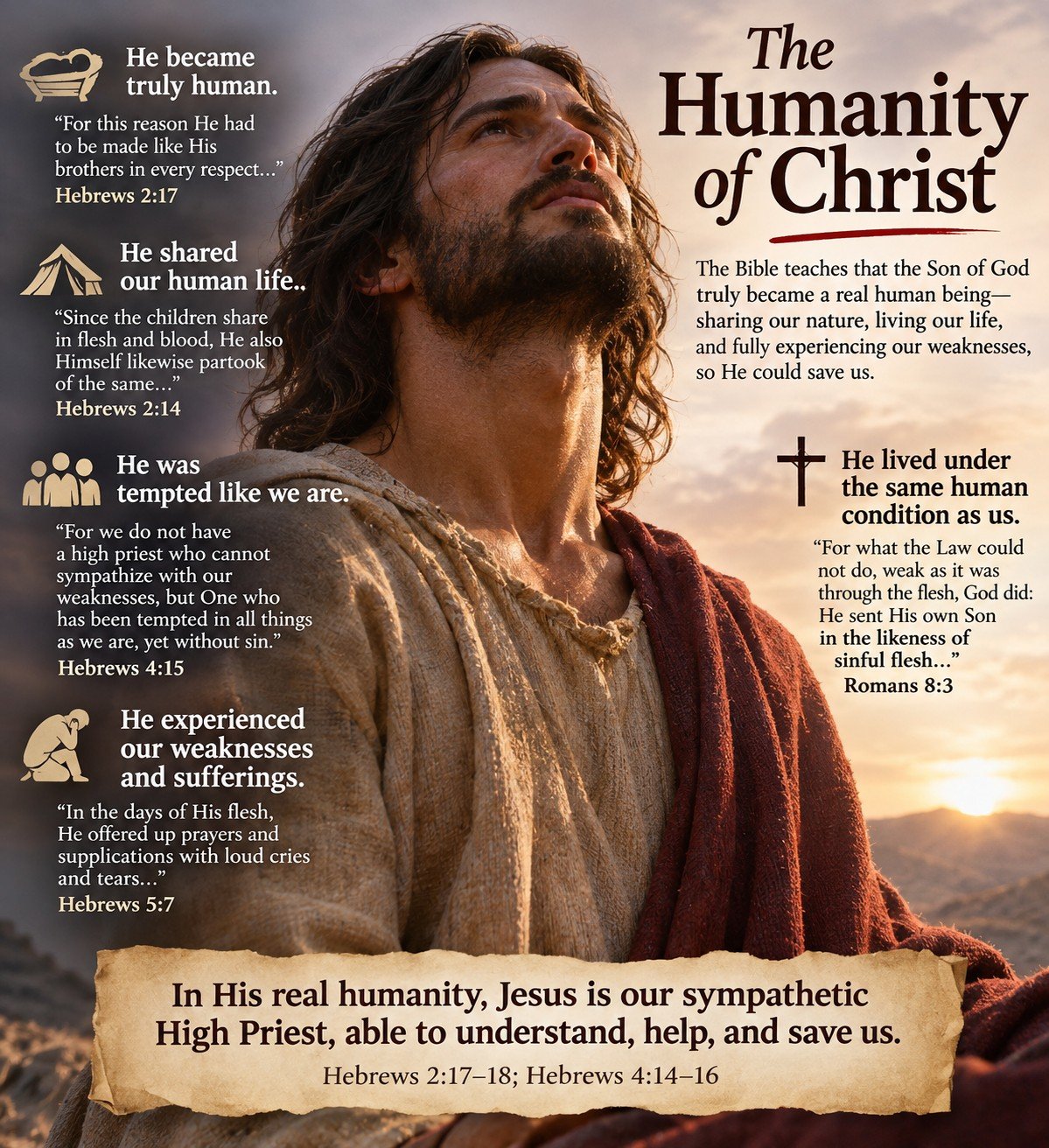
Ellen White’s Position
Earlier, we read several commentaries by well-known Protestant theologians. Now let us consider how well-known Adventist theologians and authors understood the statements of Scripture concerning the incarnation of the Son of God, beginning with the most important comments made by Ellen White.
If we read her statements on this subject only superficially, we might conclude that there are certain contradictions in them. This is because in one place she wrote that Christ assumed fallen human nature, while some of her other (relatively few) statements might suggest that He possessed the nature of Adam before the Fall.
An excellent example of such an apparent contradiction is her statement published in Signs of the Times on June 9, 1898, where she wrote:
“We should have no misgivings in regard to the perfect sinlessness of the human nature of Christ.”
If we consider only this statement, taken out of context, we might indeed understand it to mean that the Saviour assumed a sinless human nature. However, when we read the same statement in its context, we may reach a somewhat different conclusion:
“In taking upon Himself man’s nature in its fallen condition, Christ did not in the least participate in its sin… He was touched with the feeling of our infirmities, and was in all points tempted like as we are. And yet He knew no sin. He was the Lamb ‘without blemish and without spot’… We should have no misgivings in regard to the perfect sinlessness of the human nature of Christ.” (Ellen G. White, Signs of the Times, June 9, 1898; SDA Bible Commentary, vol. 5, p. 1131)
Thus, as the context clearly shows, the author explains that although the Son of God assumed “man’s nature in its fallen condition,” He “did not in the least participate in its sin.” For this reason, “we should have no misgivings in regard to the perfect sinlessness of the human nature of Christ,” because in that nature Christ never sinned!
One of the differences between Christ’s human nature and ours is that our fallen nature has sinned, whereas His human nature, although also fallen, never sinned. For this reason, it can also be described as a “perfectly sinless nature.”
In another passage, Ellen White wrote that Christ:
“Overcame in the same nature over which in Eden Satan obtained the victory.” (The Youth’s Instructor, April 25, 1901)
Since Adam in Eden possessed a sinless nature, we might conclude that Christ also assumed such a nature.
But if, in the author’s opinion, Christ’s humanity was indeed sinless, how can we reconcile this quotation with her many other statements expressing the opposite view?
Here are just a few of the numerous quotations that clearly support the view that Christ assumed sinful human nature:
“He took upon Himself our sinful nature.” (Review and Herald, December 15, 1896)
“He took upon Himself fallen, suffering human nature, degraded and defiled by sin.” (The Youth’s Instructor, December 20, 1900)
“Christ did in reality unite the offending nature of man with His own sinless nature, because by this act of humiliation He would be enabled to pour out His blood in behalf of the fallen race.” (Ellen G. White, Manuscript Releases, vol. 17, p. 26; Manuscript 166, 1898, pp. 9–10)
Since the author so clearly supports the view that Christ assumed fallen humanity, why would she suggest that the Saviour assumed a sinless nature when she wrote that Christ “overcame in the same nature over which in Eden Satan obtained the victory”?
Once again, we find the solution to this problem in the context of her statement, because Sister White went on to write:
“The enemy was overcome by Christ in His human nature. The power of the Saviour’s Godhead was hidden. He overcame in human nature, relying upon God for power.” (The Youth’s Instructor, April 25, 1901)
“Christ is called the second Adam… He voluntarily passed over the ground where Adam fell, and redeemed Adam’s failure.” (The Youth’s Instructor, June 2, 1898)
When she wrote that Christ “overcame in the same nature over which in Eden Satan obtained the victory,” she probably did not mean whether that nature was sinful or sinless, but simply that it was “human” nature, representing humanity. Both Adam in Eden and Christ, who is called the “Second Adam,” represented the entire human race in their struggle against Satan (Romans 5:12–21).
In none of her statements could Sister White have meant that Christ came in the sinless nature of Adam before the Fall, because this would contradict her other statements, which clearly support the view that Christ assumed the nature Adam possessed after the Fall.
Another statement she made in the same year, 1901, demonstrates that in this controversial passage she could not have meant that Christ overcame Satan in a sinless nature:
“The nature of God, whose law had been transgressed, and the nature of Adam, the transgressor, met in Christ, the Son of God and the Son of man.” (Ellen G. White, Manuscript 141, 1901)
She did not write here that God’s nature was united in Christ with Adam’s nature before the Fall, but with the nature of Adam, who had already become a transgressor of God’s Law. And as a transgressor, he could possess only a sinful nature.
Another statement by Sister White may be very helpful in understanding what she meant when she wrote that Christ “overcame in the same nature over which in Eden Satan obtained the victory”:
“Christ conquered on the very point where Adam failed. Our first parents were placed in Eden and had everything that could qualify them to render obedience to God. But Christ took upon Himself our fallen nature, and was subject to every temptation to which man is subject.” (Ellen G. White, Sermons and Talks, vol. 2, p. 235)
This passage tells us that “Christ conquered on the very point where Adam failed,” because, like Adam, Christ—the “Second Adam”—represented humanity. However, concerning the nature in which He achieved this victory, Sister White clearly explains that it was our fallen nature, not the nature of Adam before the Fall.
When Ellen White wrote that “Christ conquered on the very point where Adam failed,” she may also have meant that both Adam and Christ were initially tempted on the point of appetite. This possibility is supported by another statement of hers:
“Christ began the work of redemption just where the ruin began. His first test was on the same point where Adam failed. It was through temptations addressed to the appetite that Satan had overcome a large proportion of the human race, and his success had made him feel that the dominion of this fallen planet was in his hands. But in Christ he found one who was able to resist him.” (Ellen G. White, Christian Temperance and Bible Hygiene, p. 16)
Therefore, regardless of what Sister White meant when she wrote that Christ “overcame in the same nature over which in Eden Satan obtained the victory,” she certainly did not intend to suggest that He possessed the nature of Adam before the Fall.
Sinful Inclinations
The passage most frequently quoted in support of the claim that Jesus assumed a sinless human nature, free from sinful inclinations, is Ellen White’s private and personal letter to Baker, written around 1895.
Sister White sent this letter from Australia to a young pastor who was working at that time in Tasmania, an island near Australia. In this letter, Ellen White wrote:
“Be careful, exceedingly careful as to how you dwell upon the human nature of Christ. Do not set Him before the people as a man with the propensities of sin…
Jesus took upon Himself human nature, and was tempted in all points as human nature is tempted. He could have sinned; He could have fallen, but not for one moment was there in Him an evil propensity…
Never, in any way, leave the slightest impression upon human minds that a taint of, or inclination to, corruption rested upon Christ, or that He in any way yielded to corruption…
Let every human being be warned from the ground of making Christ altogether human, such an one as ourselves; for it cannot be.
It was indeed a humiliation for Him to find Himself as a man, that He might understand the force of all temptations wherewith man is beset.” (Ellen G. White, Letter to Baker, SDA Bible Commentary, vol. 5, pp. 1128–1129)
This passage clearly shows that, in Ellen White’s understanding, Christ did not possess “sinful” or “evil inclinations.”
Now let us consider several other statements of hers that seem to contradict what we have just read.
On February 17, 1994 (that is, relatively recently), Adventist Review announced that a previously unpublished letter by Ellen White had been discovered. She had written it on August 29, 1903, at Elmshaven, California, and addressed it to Dr J. H. Kellogg.
For some reason, this document had not previously been archived. It was not until December 1993 that the archivist Tim Poirier discovered the letter, rather by chance.
This statement by Ellen White is now regarded as one of the strongest arguments supporting the view that, according to her, Christ must have assumed our fallen nature.
Here is a faithfully translated passage from this letter concerning the incarnation of the Son of God:
“(Christ) came as a man, to meet and be subjected to all the evil tendencies inherited by man, which were working in every conceivable way to destroy His faith. In this way He made it possible for Himself to be buffeted by human agencies inspired by Satan.” (Ellen G. White, Letter 303, 1903)
These are extraordinarily bold and radical words, which I myself would never dare to say or even read aloud if I were not certain who their author was.
This quotation leaves not the slightest doubt that Ellen White was convinced that the Lord Jesus had to struggle against “all the evil tendencies inherited by man.”
Moreover, in those days, it was not only Ellen White, Waggoner, Jones, and Prescott who openly expressed their belief that the Lord Jesus had to struggle against the inclinations of our nature. This view was also consistent with the belief generally held in the Church at that time.
An example is a statement made in 1900 by M. C. Wilcox, who was then the editor of Signs of the Times:
“In the womb of His mother, Christ received sinful flesh. It was flesh possessing the inclinations to sin that are found in the flesh of all the sons of Adam… Yet, although He possessed this flesh with its sinful tendencies, He never sinned. Living faith enabled the Spirit of God to rule over all these fleshly inclinations.” (M. C. Wilcox, Signs of the Times, STI/03/1900, p. 1)
Bible Lessons, second quarter of 1909, p. 8:
“Divinity dwelt in human flesh, not sinless flesh, but such as the children of this earth possess… And in this sinful flesh, the divine Offspring could manifest the glory of God, even with complete and perfect victory over the tendencies of that flesh.” (Bible Lessons, second quarter, 1909, p. 8)
The next quotation comes from the book Bible Readings for the Home, a very comprehensive handbook discussing various biblical truths. This book was published in 1915, and more people were baptised after reading it than after reading any other book.
On page 115 of the original edition (this passage was removed in 1946), the authors clearly expressed the view held by the Adventist Church at that time concerning the incarnation of the Son of God:
“In His humanity Christ partook of our sinful, fallen nature… The idea that Christ was born of an immaculate or sinless mother, and that He inherited no tendencies to sin, and for this reason did not sin, removes Him from the realm of a fallen world, from the very place where help is needed. On His human side, Christ inherited just what every child of Adam inherits—a sinful nature.” (Bible Readings for the Home, 1915, p. 115)
In her statements concerning Christ’s nature, Ellen White repeatedly indicates that Christ had to struggle against the inclinations to sin that are characteristic of our nature:
“Though He had all the strength of passion of humanity, never did He yield to do one single act which was not pure.” (Ellen G. White, In Heavenly Places, p. 155)
“Adam was tempted by the enemy, but it was not indwelling sin that caused his fall, for God made him pure and upright in His own likeness. There were in him no corrupt principles, no tendencies to evil. But when Christ came to meet the temptations of Satan, He bore the likeness of sinful flesh.” (Ellen G. White, Signs of the Times, October 17, 1900)
“From experience Christ knows what are the weaknesses of humanity, what are our wants, and where lies the strength of our temptations; for He was in all points tempted like as we are, yet without sin.” (Ellen G. White, Manuscript 15, 1897)
“Christ knows what it is to struggle with the sinner. He knows his temptations. He took upon Himself our nature. The strongest temptations of the Christian come from within, for he must battle against the natural inclinations of the heart. The Lord knows our weaknesses.” (Ellen G. White, Christ Tempted as We Are, 1894, 1888 Message collection)
I found another very interesting statement by Ellen White in the 1962 issue of Sługa Zboru:
“His soul was pressed with the burden of the sins of the world… He realized the strength of indulged appetite and of unholy passion that controlled the world…” (Ellen G. White, Review and Herald, August 4, 1874)
The above statements provide undeniable evidence that Ellen White repeatedly and clearly expressed her belief that the incarnation of the Son of God involved His assumption of sinful rather than sinless humanity.
How, then, are we to understand the fact that, on the one hand, she wrote that Christ did not have “evil inclinations,” while on the other hand, she explained that He was “subjected to all the evil tendencies inherited by man”?
We can resolve these apparent contradictions only if we take into account that there are “evil” or “sinful inclinations” which are already sin, and others which, as James puts it in his epistle, have not yet “conceived” and “brought forth sin”:
“…when desire has conceived, it gives birth to sin…” (James 1:15)
Although the word “desire” used here may be associated with sin, according to this passage there is also a desire (inclination) which is not yet sin, but rather an inner force familiar to all of us. It makes temptation more powerful and causes our “sinful flesh” to suffer when we resist it. However, according to the Word of God, desire itself, in this sense, is not yet sin. It becomes sin only when it “conceives,” that is, when a person yields to that desire.
On the other hand, we realise that there are also “sinful desires” and “inclinations,” such as immoral thoughts or evil inclinations resulting from indulgence in sin.
Such desires are already sinful in themselves. Therefore, the Lord Jesus undoubtedly did not possess such evil inclinations or sinful desires, if only because He never indulged in sin.
This does not mean, however, that He could not struggle against inclinations and desires that had not yet been accepted in His mind and therefore had not developed into sin. They merely urged Him towards sin, but the Lord Jesus never yielded to them, even in the slightest degree.
In 1983, the well-known Adventist theologian Herbert Douglass explained in an interesting way why Christ never had evil inclinations, even though He struggled against the inclinations of our nature:
“Our Lord struggled with genuine temptations, those which truly entice us to satisfy even our noble desires, but in a selfish way. Yet Jesus never, even for a moment, allowed these temptations to conceive and bring forth sin. He too fought difficult battles with Himself and against hereditary tendencies, but He never allowed any inclination to become a sinful inclination (see James 1:14–15). He always said no, whereas all other human beings have said yes. And therefore we can say that Jesus never had evil inclinations, because He never sinned.” (Herbert Douglass, Adventist Review, December 29, 1983)
A similar view was expressed by another well-known Adventist theologian, J. H. Durland, who wrote in 1895:
“Christ did not assume the nature of angels, nor did He assume human nature as it was before the Fall… If He had assumed Adam’s sinless nature, He could not have come under the sentence of death that fell upon all humanity…
He did not possess the lusts of our sin-dominated fallen nature. However, the flesh He assumed would quickly have become the dwelling place of all the lusts that sin has brought upon us if He had yielded to them even once. He struggled with temptation in weak, sinful flesh… He assumed sinful flesh so that He might overcome the corruption of our old nature.” (J. H. Durland, October 10, 1895, BV 245, p. 5)
In December 1985, the Adventist magazine Ministry published an interesting statement concerning the difference between evil and natural inclinations. Its author was Joe Crews:
“Evil inclinations must not be confused with natural inclinations. Some claim that Jesus could not have possessed evil inclinations because they cause a person to cling to sin… Jesus, however, possessed natural inclinations, the kind we all possess, because He, like every one of us, was born with a fallen nature.
Evil inclinations are those which cause a person to yield to sin and cling to it, because they have been cultivated and developed through continual indulgence in sin. Natural inclinations, on the other hand, are inherited. Unlike the former, they carry no guilt. They are not sinful inclinations until the person who possesses them yields to them.” (Joe E. Crews, Ministry, December 1985)
The view expressed here by Joe Crews appears to agree with Ellen White’s position, because she wrote:
“(Christ) knows how strong are the natural (that is, inherited) inclinations of the heart.” (Ellen G. White, Testimonies for the Church, vol. 5, p. 177)
Other very important quotations, also taken from Ellen White’s writings, may provide an essential clarification of the above statement:
“We must not think that Christ’s liability to yield to temptation degraded His humanity, and that He therefore possessed the same corrupt inclinations as man… Christ took our nature—fallen, but not corrupted.” (Ellen G. White, Manuscript 57, 1890)
This is a very important quotation because:
First, it shows that Christ possessed a liability to yield to temptation.
Second, this liability did not degrade His humanity.
Third, the fact that Christ struggled with the liability to yield to temptation does not mean that He possessed corrupt inclinations.
Fourth, this passage shows that Christ possessed a nature that was “FALLEN, but not CORRUPTED.”
However, if we still have doubts about whether, according to Ellen White, the Lord Jesus could truly be tempted as we are, her next statement should remove those doubts:
“Temptation is resisted when man is powerfully influenced to do a wrong action, and, knowing that he can do it, resists, by faith, with a firm hold upon divine power.
This was the ordeal through which Christ passed.” (Ellen G. White, The Youth’s Instructor, July 20, 1899)
Taking the above statements into account, we can now understand why Ellen White indicated in one place that Christ did not have “evil inclinations,” while elsewhere she wrote that He was burdened with them.
She probably meant that although, on the one hand, the Saviour did not possess “evil inclinations,” that is, “desires” which had already “conceived” and thus “brought forth sin,” on the other hand, He struggled against those “evil (natural) inclinations” which had not yet “conceived” and developed into sin.
We can therefore confidently suggest that the Lord Jesus, like His “brethren,” that is, the “seed of Abraham,” and like all of us, was also tempted inwardly.
This was, for example, the view of Herbert Douglass, who wrote in Adventist Review in 1983:
“Ellen White makes it clear that fallen, degraded human nature could not force Christ to sin, either in action or in thought. He remained undefiled and pure, despite being tempted not only outwardly but also inwardly.” (Herbert Douglass, Adventist Review, December 29, 1983)
Jack Sequeira offers an interesting explanation of how Christ could be “tempted in all points as we are, yet without sin” in his book Beyond Belief, published by the Adventist publishing house Pacific Press:
“We must remember that the Son of God was born of the Spirit while still in Mary’s womb (Luke 1:35). Therefore, from the very beginning of Christ’s earthly existence, His mind (soul) was under the constant control of the Holy Spirit, who dwelt in His human spiritual nature: ‘And the Child grew and became strong in spirit’ (Luke 2:40).
Temptations came to Christ in the same way they come to us, that is, through the sinful and self-centred desires of the flesh. It was through the desires of the flesh that Satan tempted Jesus in the wilderness, trying to persuade Him to use His divine power to satisfy His own needs independently of the Father’s will (Luke 4:2–4)… However, these self-centred desires of the flesh cannot be satisfied unless they are accepted by the mind. Temptation itself never becomes sin until we yield to it in our minds: ‘When desire has conceived (in the mind), it gives birth to sin’ (James 1:15). And because Christ’s mind was under the constant control of the Holy Spirit, His response to every temptation was: No! Therefore, in Christ’s life, sin had no power, and it was condemned in His flesh (Romans 8:3).” (Jack Sequeira, Beyond Belief, pp. 146–148)
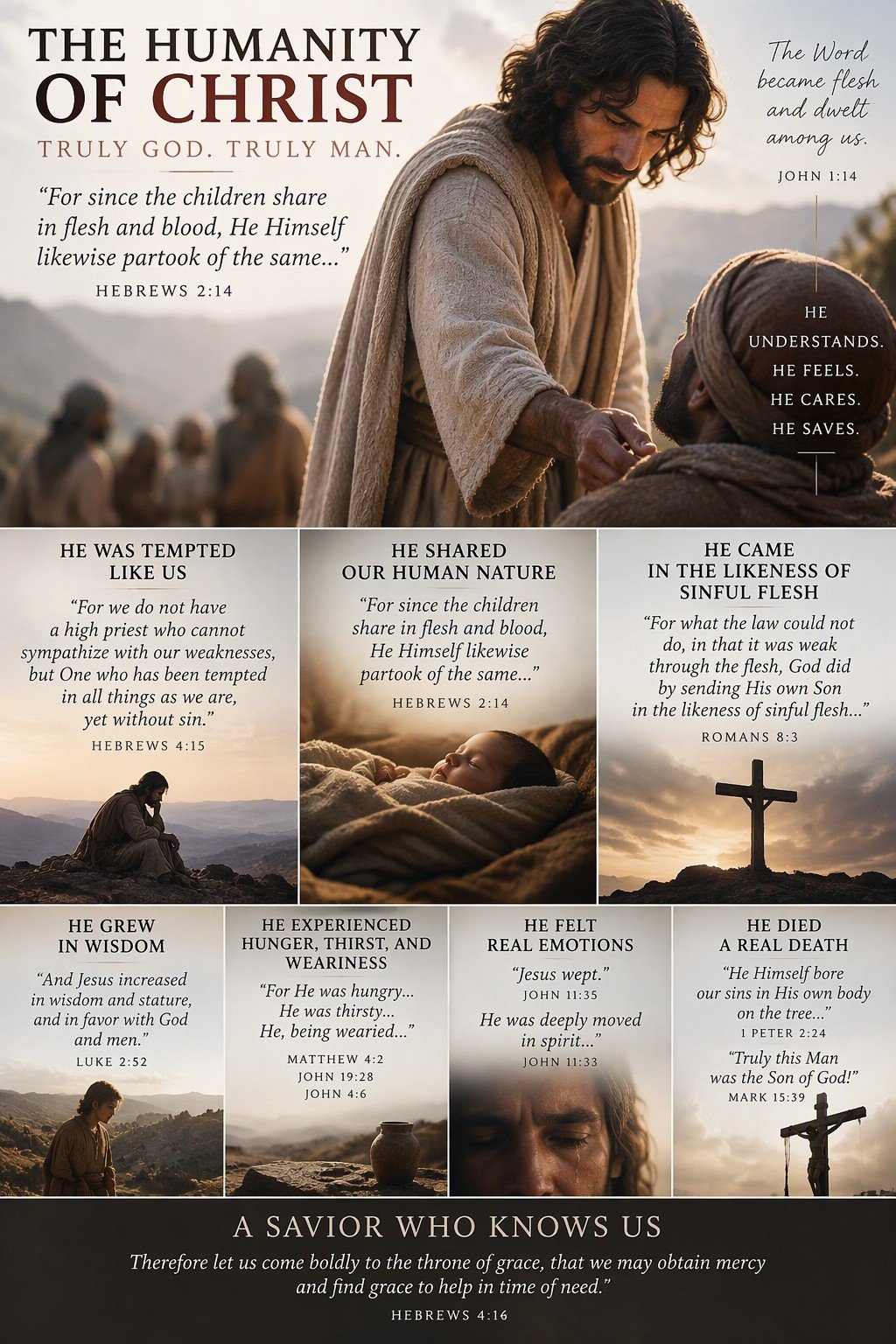
The Foundation of the Minneapolis Message (Waggoner’s Views)
Because the incarnation of the Son of God truly is “everything” to us, the humanity of Jesus Christ was also one of the most important aspects of the message proclaimed at the Minneapolis Conference in 1888. Let us now consider how Waggoner understood this subject at that time.
Just a few months after the Minneapolis Conference, Waggoner wrote a series of articles about the humanity of Christ in Signs of the Times. Their contents were later included in the book Christ Our Righteousness. Here are several excerpts from those articles:
“It must have been sinful man that He was made in the likeness of, for it was sinful man that He came to redeem… Christ took upon Himself the flesh, not of a sinless being, but of sinful man, that is, flesh possessing all the weaknesses and sinful tendencies to which human nature is subject. This fact is presented in the statement that Christ was made of the seed of David according to the flesh.” (E. J. Waggoner, Christ Our Righteousness, 1890, pp. 26–30)
Waggoner’s commentary on 1 Peter 2:24 is also very interesting. This passage states that Christ “Himself bore our sins in His own body on the tree” (the original and the English text say “in His own body”):
“Our sins were not merely symbolically laid upon Him, but were in His own body. He became a curse for us, was made sin, and consequently suffered death for us… The same text which says that He Himself bore our sins in His own body on the tree also shows us that Christ committed no sin. He was made sin for us, but He Himself committed no sin.”
It is also worth mentioning that what Waggoner taught about the incarnation of Christ, both before and after the Minneapolis Conference, was consistent with what other Adventists and Church leaders believed.
The unjustified opposition to what he preached was initially caused only by a misunderstanding of his interpretation of the law in the Epistle to the Galatians.
The best evidence that his views on the humanity of Christ were in harmony with what our Church and Ellen White taught on this subject at that time is that, after Minneapolis, Waggoner was invited no fewer than three times to take an active part in General Conference sessions. On each occasion, he also addressed subjects connected with the human nature of the Saviour.
Thus, during the General Conference session in 1891 (three years after Minneapolis), he presented 16 sermons devoted to the Epistle to the Romans, once again expressing the view that Jesus assumed fallen humanity.
Then, in 1897, he was invited to present 19 sermons during the General Conference session, based on those chapters of the Epistle to the Hebrews that deal with the incarnation of the Son of God.
Once again, Waggoner had the opportunity to speak about the humanity of Christ, and his presentations met with the recognition and approval of the delegates. Had this not been the case, he certainly would not have been invited to travel such a long distance from England to the United States.
Once again, the General Conference Committee invited Waggoner to participate in the 1901 session so that, together with Ellen White, he could help refute the “strange doctrine” associated with the “Holy Flesh” movement—a doctrine that rejected the possibility that Christ had assumed sinful humanity.
For this very reason, on April 16, 1901, in the presence of Ellen White and the delegates, Waggoner delivered a lengthy presentation demonstrating that Christ did not possess “holy flesh,” that is, He did not assume the nature of Adam before the Fall.
The “Holy Flesh” movement arose around 1898, and its supporters, contrary to the view generally accepted by Adventists at that time, taught that Christ assumed the nature of Adam before the Fall and therefore possessed “holy flesh.”
This belief provided the basis for claiming that believers could also obtain the same “holy flesh” by following the experience Christ went through in Gethsemane.
In this way, those who followed Christ could attain a similar state, even physical sinlessness, and experience “translation” like Enoch or Elijah.
Here is an excerpt from a letter addressed to Ellen White by Haskell, in which he informed her about the fanatical views of the supporters of this group, based on the doctrine of Christ’s sinless humanity:
“When we expressed our belief that Christ was born in fallen humanity, they regarded us as people who believed that Christ had sinned. This was despite the fact that we presented our position so clearly that no one should have misunderstood us…
They believe that Christ assumed the nature of Adam before the Fall, and therefore His humanity was holy. Consequently, they claim that this special time has now come for us also to become holy on the same basis, and to possess the faith necessary for translation without ever experiencing death.” (S. N. Haskell, letter to Ellen White, September 25, 1900)
Here is an interesting excerpt from Ellen White’s response to Haskell concerning the Holy Flesh heresy, which was based on belief in Christ’s sinless humanity:
“The third angel’s message must be free from all the cheap, miserable, man-invented theories prepared by the father of lies, and disguised as was the shining serpent used by Satan as a medium to deceive our first parents.” (Ellen G. White, Selected Messages, vol. 2, p. 37)
Therefore, on the basis of Waggoner’s statements, we can clearly conclude that, according to the Minneapolis message, the humanity Christ assumed must have been our sinful humanity.
According to Ellen White’s testimony, the Minneapolis message, which was founded upon the incarnation of the Son of God, came from God, was intended to bear fruit in the outpouring of the Holy Spirit, and was the message of the third angel in Revelation 18:1.
A very strong and undeniable argument is that the truth about Christ’s assumption of fallen humanity formed a very important part of the Minneapolis message. Concerning the Minneapolis message, Sister White wrote that it came from God and that this remained true even though Waggoner and Jones were later led astray. Since we have testimony that the Lord gave us this message, how can we reconcile that with the claim that one of its fundamental elements could have been contrary to the truth?
Since Ellen White herself wrote that the incarnation of Christ is such an important and sacred subject that it is “everything” to us, how can anyone suppose that the knowledge God gave Waggoner and Jones concerning this subject was mistaken? Someone may argue that the situation at Minneapolis was similar to what happened at the beginning of the Advent Movement. In other words, God entrusted these preachers with only part of the truth, intending to develop it gradually over time by revealing new truths and removing errors. However, such an argument cannot be applied to the message of 1888, because Ellen White’s testimonies indicate that if the Church had fully accepted what Waggoner and Jones preached at that time, the end would have come shortly afterwards. Five years after Minneapolis, Ellen White wrote that if this truth had been properly received, Christ would already have returned by then! If that is so, then surely the foundation of this message—the truth about Christ’s incarnation—could not have required any further correction. Perhaps Waggoner or Jones made other mistakes, but the teaching concerning the humanity of Christ was, and still is, too sacred and precious to Christ Himself and to God for this truth to have been contaminated by any falsehood in the final message the Lord intended to give His people!
Would God entrust His people with the final message if one of its most important teachings were contrary to the truth? This is just one of many questions to which, so far, no one has given me an answer.
Would Christ Have Become a Sinful Being by Assuming Our Fallen Nature?
Perhaps the argument most frequently repeated by those who believe that Christ assumed sinless humanity is the claim that if the Son of God had assumed our fallen nature, He would have become a sinful being and would Himself have needed a saviour.
However, we must remember that although in our case possessing a fallen nature means that we are indeed sinful, this was not the case with Christ, because in Him this fallen human nature was mysteriously united with His divine nature.
Ellen White explains this in a similar way, writing that just as Christ was not defiled when He touched a leper, so also, despite assuming fallen humanity, He did not become unclean, precisely because, unlike us, He possessed a divine nature:
“The disciples sought to prevent their Master from touching the leper, for whoever touched him became unclean.
But Jesus, in laying His hand upon the leper, received no defilement…
Thus it is with the leprosy of sin… Jesus received no defilement when He came to dwell in humanity.” (Ellen G. White, The Ministry of Healing, p. 70)
And it was precisely for this reason that Sister White could also write:
“In taking upon Himself man’s nature in its fallen condition, Christ did not in the least participate in its sin.” (Ellen G. White, SDA Bible Commentary, commentary on Hebrews 4:15)
To illustrate this problem more clearly, let us use numbers. Suppose that the Son of God came into our world as a symbolic Seven, representing His perfect divine nature. Then, as Seven, He entered zero, representing sinful human flesh.
However, this did not diminish His holiness in the slightest, because 7 + 0 equals neither 0, nor 1, 3, or even 6, but still 7!
We can therefore say that the “body of sin” which Christ assumed could not take anything away from His holiness, because, unlike us, He also possessed the divine nature (the “Seven”).
The internationally renowned Protestant theologian C. E. B. Cranfield, professor of theology at Durham University, explains this issue in the following way when commenting on Paul’s expression in Romans 8:3 that Christ came “in the likeness of sinful flesh”:
“Paul’s intention here was not to cast doubt on the authenticity of Christ’s sinful flesh, but merely to draw attention to the fact that although the Son of God truly assumed this sinful flesh, He never became sinful flesh…
By using the words in the likeness of, Paul meant that although Christ assumed the same fallen nature that we possess, unlike us, this was not all that He possessed. He never ceased to be also the Eternal Son of God.” (C. E. B. Cranfield, The Epistle to the Romans, International Critical Commentary, vol. 1, p. 379)
The Bible provides a very good illustration of the fact that Christ’s assumption of our fallen nature did not make Him a sinful being.
Indeed, Jesus Himself is called the “Word” in the first chapter of the Gospel of John:
John 1:1, 14
“In the beginning was the Word, and the Word was with God, and the Word was God…
And the Word became flesh and dwelt among us…” (John 1:1, 14)
The Word of God, which symbolises Christ Himself, was written by people who were believers, but who were also sinful and possessed fallen natures.
Does this fact, however, mean that we can describe the Bible as a sinful and imperfect book?
No! Why not?
We do not say that the Bible is an imperfect and sinful book because, although it was written by sinful people, they were inspired by the Holy Spirit. For this reason, we call this book the “HOLY Scriptures,” not the “sinful Scriptures”!
This is precisely because, although the Word of God was written by sinful people, it was also “sanctified” and “given life” by the Holy Spirit. This was possible because in the Holy Scriptures (the Word of God), just as in Christ, that which was human and sinful was united with that which was divine and holy.
Therefore, despite assuming our fallen nature, Christ does not deserve to be called a sinful man, because in Him sinful humanity was united with the holy divine nature and was given life and sanctified by the presence of the Holy Spirit.
Suppose we place a piece of paper representing us—sinful human beings—inside a Bible, which symbolises Christ. Then this Bible, with the piece of paper inside it, is sent to China. Unfortunately, China is still a communist country, so when a postal official in China notices that it is a Bible, he immediately orders it to be burned. And when the Bible is burned, the piece of paper inside it is burned as well.
And it was in exactly the same way that God accomplished our salvation in Christ. Because Christ identified Himself with our corporate humanity, God, as it were, placed us in Him. In Him, we were perfectly obedient to the law, and in Him we also suffered the penalty for sin, which is death.
“Partakers of the Divine Nature”
Another interesting argument showing that Christ’s assumption of fallen nature did not diminish His holiness is found in what the apostle Peter wrote in 2 Peter 1:4.
According to this passage, a believer becomes a “partaker of the divine nature” at the moment of the new birth.
Sister White also wrote that “man must become a partaker of the divine nature.” (Selected Messages, book 1, p. 408)
Despite this fact, none of us can say that because a believer is a “partaker of the divine nature,” he automatically becomes a sinless being and a god.
Likewise, none of us should say that because Christ became a partaker of our fallen nature, He became a sinful man.
The Humanity of Christ and the Doctrine of the Immaculate Conception of Mary
When discussing the incarnation of the Son of God, we should also recognise that acceptance of the doctrine of Christ’s sinless humanity has been used by the enemy of the gospel to distort the truth of salvation by faith in Christ alone.
On December 21, 1905, Review and Herald published an editorial response to a question from a reader who expressed doubts about whether Christ could remain holy while dwelling in “sinful flesh.”
The reader also suggested that the Bible does not say that God sent His Son “in sinful flesh,” but “in the likeness of sinful flesh.”
Here is an excerpt from the response given to these questions by the editors of Review and Herald at that time:
“If the Son of God, when He came into this world, did not dwell in sinful flesh, then the ladder from heaven would not have reached the earth, and the gulf between a holy God and fallen man would still remain unbridged.
In such a situation, it would be necessary to supply the missing rungs of the ladder to establish a connection between a holy God and sinful man.
And this is exactly what the Catholic Church did by introducing the doctrine of the Immaculate Conception of Mary, according to which the mother of Jesus was specially privileged and preserved immaculate, that is, free from original sin.
And because, as a mother, she was entirely different from other women, the flesh that Jesus received from her was also different from the flesh of other human beings.
In this way, however, a gulf would still remain between Jesus and man in sinful flesh. Therefore, the Roman Church introduced a system of mediation between the Son of God and man in sinful flesh.
The first link consists of priests on earth, who possess sinful flesh; then those who once lived in sinful flesh but were subsequently canonised by the Church and recognised as saints in heaven; and then the angels.
Mary was established as the final link connecting sinful man with Christ.
This Catholic doctrine, resulting from the belief that Christ assumed a sinless nature, is very dangerous and directly attacks the teaching of justification by faith in Christ alone, because accepting this false teaching means that the door to heaven is not Jesus, but the Church.
And to open this door, according to this Catholic doctrine, all that is required is the price that the sinner or his relatives are able to pay. These are the consequences of the doctrine which teaches that Christ did not partake of sinful flesh…
We trust that none of our readers will accept this false papal doctrine merely because they are unable to understand what the Bible calls the mystery of godliness. It is safe to believe the clear teachings of Holy Scripture.” (Review and Herald, December 21, 1905, editorial response)
The Catholic Parallel: Separating Christ from the Humanity that Needed Redemption
Knight also differs from Sequeira concerning the humanity Christ assumed. He accepts that Christ took humanity after the Fall and experienced its physical weaknesses, but he does not believe Christ inherited moral and spiritual dimension of fallen human nature, meaning that His human nature was deprived of the indwelling “law of sin” (from Romans 7 and Romans 8:2-3).
There is another serious consequence of the position represented by George Knight, Raoul Dederen, Ángel Manuel Rodríguez and a number of other modern Adventist theologians. Although these writers do not formally accept the Roman Catholic doctrine of the Immaculate Conception of Mary, their understanding of Christ’s humanity produces an important Christological parallel with the result achieved in Catholic theology: Christ becomes separated from an essential aspect of the fallen humanity He came to redeem.
The Roman Catholic doctrine of the Immaculate Conception does not refer to Christ’s conception. It teaches that Mary herself, from the first moment of her conception, was preserved from original sin. Pope Pius IX formally defined the doctrine in 1854, declaring that Mary was preserved “free from all stain of original sin.”
This Catholic doctrine provides a theological means of maintaining that Christ genuinely received His humanity from Mary while remaining free from the inherited sinful condition attributed to ordinary descendants of Adam. Mary herself is first made an exception to the ordinary fallen condition of humanity; Christ can consequently receive humanity through a mother preserved from original sin.
Adventists such as Knight, Dederen and Rodríguez do not need an immaculate Mary to reach a partly similar Christological result. They reject the Catholic doctrine, yet the crucial question remains: If Christ inherited our physical infirmities but was exempted from the deeper fallen condition and sinful propensities regarded as characteristic of ordinary fallen humanity, has His humanity not again been separated at a crucial point from the humanity that actually needed redemption?
The theological mechanism is different, but the resulting Christological separation deserves serious attention.
This does not by itself prove that Knight, Dederen or Rodríguez consciously intended to introduce Catholic theology into Adventism. Intention would require separate historical evidence. But theological ideas must be judged by their consequences regardless of intention. An Adventist Christology can reject the Immaculate Conception by name while nevertheless moving toward a comparable separation between Christ’s humanity and the fallen humanity He came to redeem.
Knight’s reinterpretations are considered by critics as a attempts of Catholicising and ecumenical trend within modern Adventism, associated in different theological areas with figures such as Raoul Dederen, Ángel Manuel Rodríguez, Jon Paulien and others. From this perspective, distinctive historic Adventist teachings that created a clear theological separation between Adventism and Roman Catholicism have progressively been weakened, reinterpreted or abandoned, making Adventism increasingly compatible with the wider ecumenical movement.
A particularly important example is the interpretation of 666 in Revelation 13:18. Historic Adventist interpreters famously connected the number with the papal designation Vicarius Filii Dei, whose Roman-numeral letters total 666. Rodríguez moved away from making this identification the primary meaning of the number and promoted a symbolic interpretation:
“It appears that the triple six stands for the satanic triumvirate in contrast to the triple seven of the Godhead in Revelation 1:4–6.” (Ángel Manuel Rodríguez, Adult Sabbath School Bible Study Guide: Great Apocalyptic Prophecies, April–June 2002, pp. 85–86.)
Jon Paulien also rejects the traditional Adventist interpretation that 666 refers to the papal title Vicarius Filii Dei. Instead, he interprets 666 mainly as a symbol of human imperfection and rebellion against God.
From this critical perspective, these developments are not insignificant academic adjustments. They Catholicise Adventism by removing or weakening doctrines and prophetic interpretations that historically distinguished the Seventh-day Adventist message from Roman Catholic theology. The resulting theology is considerably more Catholic-friendly and makes Adventist participation in the wider ecumenical movement easier. Critics see this movement as ultimately serving the ecumenical objective of bringing separated Christian bodies increasingly closer to Rome.
The Biblical Solution Requires No Immaculate Mary
The biblical solution does not require an immaculate Mary. Neither does it require Christ to receive an artificially insulated humanity.
Mary herself needed a Saviour: “My spirit has rejoiced in God my Savior.” (Luke 1:47) Christ therefore genuinely entered Adam’s fallen human family through Mary while remaining Himself absolutely without sin.
The solution is not to change the humanity Christ assumed. The solution is to distinguish fallen human nature from personal sin.
Christ could assume humanity damaged by the Fall without becoming a sinner. His person remained holy. His character remained spotless. His will never consented to sin. Yet He genuinely entered our fallen humanity and overcame where humanity had failed.
Thus Hebrews can declare that He “was in all points tempted as we are, yet without sin.” (Hebrews 4:15)
And Romans can declare that God sent His Son “in the likeness of sinful flesh” and “condemned sin in the flesh.” (Romans 8:3)
The glory of Christ’s victory is therefore not that He defeated sin from a humanity insulated from our fundamental problem. He entered our fallen humanity and conquered sin where sin had conquered us.
Fallen Nature, but Spiritually Made Alive
It is possible that the long-standing controversy over the kind of humanity Christ assumed could become less intense if we all made the effort, with humility and prayer, to find the answer to this question:
In what aspects did Christ assume our nature?
Did He share our sinful humanity in its physical, moral, or spiritual aspects?
One of the most popular views among Christians is that Christ did indeed unite Himself with our fallen humanity, but only in the physical sense. This means that, like us, He could experience tiredness, pain, and the effects of ageing.
However, nowhere in Holy Scripture can we find any justification for such a view, especially since the Word of God speaks of the need for the salvation of the whole person, not merely the physical body.
Here is what the distinguished Protestant theologian Thomas F. Torrance wrote on this subject:
“The incarnation should be understood as God’s assumption of our nature, of our actual human existence burdened with sin and guilt. Throughout the first five centuries, this doctrine was universally accepted by the early Christian Church. It was repeatedly emphasised that if the whole person was to be saved, Christ had to assume the whole of humanity, because what He did not assume could neither be healed nor saved.” (Thomas F. Torrance, The Mediation of Christ, pp. 48–49)
Similarly, nowhere in Ellen White’s writings do we find a passage suggesting that the Son of God assumed our humanity only in its physical aspect. According to her, Christ’s incarnation involved assuming not only the “form,” that is, the physical body, but also the “nature of fallen man”:
“Christ took upon Himself the form and nature of fallen man, that through suffering He might be made perfect and endure the strength of Satan’s temptations, that He might better know how to help those who are tempted.” (Ellen G. White, Spiritual Gifts, vol. 4, pp. 115–116)
If Ellen White had believed that the Lord Jesus assumed only our fallen physical nature, she would certainly have written so, because she knew very well that human nature includes, among other things, physical and moral aspects. This is demonstrated by the following statement:
“There is an intimate relation between the physical and the moral nature.” (Ellen G. White, Testimony Studies on Diet and Foods, p. 37)
Nevertheless, although she was fully aware that fallen nature has physical, moral, and spiritual aspects, she never wrote that Christ assumed only our fallen physical nature.
An excellent confirmation of this can be found in her statement in The Desire of Ages, pp. 56–57:
“Christ came to the world to redeem the failure of Adam. But when Adam was assailed by the tempter, none of the effects of sin were upon him… It was otherwise with Jesus when He entered the wilderness to cope with Satan. For four thousand years the race had been decreasing in physical strength, in mental power, and in moral worth; and Christ took upon Him the infirmities of degenerate humanity. Only thus could He rescue man from the lowest depths of his degradation.” (Ellen G. White, The Desire of Ages, pp. 56–57)
Neither here nor anywhere else did the author write that Christ assumed only the weaknesses of physical nature. Instead, after identifying physical and moral weaknesses, she explains that Christ “took upon Him the infirmities of degenerate humanity,” that is, the weaknesses she had just mentioned—all the weaknesses associated with sinful human nature in every aspect.
Moreover, our fallen nature consists of three inseparable elements, which cannot be separated from one another but must be treated as a single whole. This follows, among other things, from a statement made by Brother Zachariasz Łyko in his book Nauki Pisma Świętego (Teachings of the Holy Scriptures), p. 500:
“The concept of carnality, which is equivalent to the concept of sinfulness, is not limited exclusively to the body, that is, the physical aspect of the human being, but also includes the spiritual sphere—his psyche and his entire personality.” (Zachariasz Łyko, Nauki Pisma Świętego [Teachings of the Holy Scriptures], p. 500)
The opposite of the view that Christ assumed “sinful flesh” only in the physical sense is the belief that Christ assumed our entire fallen nature, not only in the physical sphere but also in the moral and spiritual spheres.
However, for certain important reasons which we will discuss, this second view also requires clarification.
The view that seems closest to the truth is a very interesting one that is now held by an increasing number of theologians. One of them is Thomas A. Davis, a well-known Adventist theologian, according to whom Christ’s human nature was like Adam’s nature after the Fall, with one very important difference: from the very beginning, Christ’s humanity was made spiritually alive by the Holy Spirit. In other words, it was the kind of nature that only a converted person can possess.
The following quotation, from 1979, is taken from Davis’s book Was Jesus Really Like Us?:
“The nature Christ assumed was not entirely the same as the nature of an unconverted sinner. His humanity could only have been like that of those who had experienced spiritual rebirth (and such people still possess a fallen nature, but one that has been made spiritually alive).
His fallen human nature caused Him the same difficulties that a converted person has to face.
It is therefore unacceptable to claim that His humanity was of a lower order than that of a converted person, and it is equally unthinkable that His nature was superior to the nature of a born-again person.
Jesus could not have possessed the slightest advantage over any converted person, because the new birth is the highest spiritual state a human being can attain in this present life… Jesus was a man with fallen human nature, possessing the same mental and physical inclinations that sinful human beings possess. Yet He was sinless and innocent. His will was always, without exception, in harmony with the will of His Father.” (Thomas A. Davis, Was Jesus Really Like Us?, pp. 32–97)
In the passage just quoted, Davis wrote that:
“Jesus was a man with fallen human nature, which… possessed the same mental and physical inclinations.”
Interestingly, Ellen White used the same expression:
“On Sunday afternoon I spoke to an assembly who listened with the deepest interest. I felt freedom and power in presenting Jesus, who took upon Himself the infirmities and sorrows of humanity and gained the victory in our behalf.
He had to be made like His brethren in all things, with the same mental and physical susceptibilities. He was tempted in all points like as we are, yet without sin, and He knows how to succor those who are tempted. Are you weary and troubled? So was Jesus. Do you need encouragement? He felt the same need. Just as Satan tempts you, so he tempted the Majesty of heaven. Yet Jesus, your representative and substitute, never yielded in the conflict, and in His strength you also may resist and overcome.” (Ellen G. White, Review and Herald, February 10, 1885, paragraph 7)
This statement shows beyond any doubt that, according to Ellen White, Christ did not assume only our fallen physical nature, because she wrote that the Lord Jesus “had to be made like His brethren in all things” (that is, in every aspect of human nature), with the same inclinations—not only physical but also mental!
The Spiritual Aspect of Christ’s Human Nature
“THE SPIRITUAL ASPECT: When Adam rebelled against God, the Holy Spirit departed from him. In this way, the warning given to our first parents was fulfilled: ‘In the day that you eat of it you shall surely die’ (Genesis 2:17).
The immediate result of Adam and Eve’s fall was their spiritual death, which subsequently affected all humanity. Therefore, all human beings come into this world spiritually dead (without the indwelling presence of the Holy Spirit) (Ephesians 2:1, 5) and separated from God (Isaiah 59:2).
For this reason, the humanity Christ received through Mary must also have been spiritually dead. However, we must remember something extremely important: at the moment of conception, this spiritually dead human nature of Christ was mysteriously united with His divine nature through its union with the Holy Spirit, who was present in Christ from the very moment of conception (Luke 1:35). As a result, this fallen humanity was made spiritually alive, and from the moment of conception, Christ’s fallen human nature was the same kind of nature that a believer receives at the new birth. This new birth, which Paul calls the firstfruits of the Spirit (Romans 8:23), changes the believer’s condition so that holy living and obedience to the law now become part of his desires (Hebrews 8:10).
The Moral Aspect of Christ’s Human Nature
THE MORAL ASPECT: As a result of the Fall, Adam’s sinless nature became corrupted, including in the moral sphere, and consequently came under the domination of the law of self-love.
When Christ assumed our humanity, although it had been made spiritually alive from the moment of conception, His moral nature still possessed an inborn tendency to be excessively centred on self and remained under the pressure of the law of sin.
The same is true of a converted person, because the fact that he has been made spiritually alive does not mean that his nature has also been changed in the moral sphere.
The Son of God’s assumption of our fallen nature, including its moral aspect, was the main reason why Christ’s holy life always required a struggle against the law of sin characteristic of fallen nature.
Although His mind was completely surrendered to the will of God, so that no sinful inclination or evil tendency could find a home there, His human nature was dominated by the principle that affects the entire human race—the tendency towards self-love.
This means that, in Christ’s case, holy living was not simply a matter of following natural inclinations, as it had been for sinless Adam. Instead, it required a constant struggle against the lust of the flesh, the lust of the eyes, and the pride of life.
The Physical Aspect of Christ’s Human Nature
THE PHYSICAL ASPECT: By assuming our sinful humanity, the Son of God identified Himself not only with our moral weaknesses but also with our physical weaknesses. This is precisely why He was subject to tiredness, ageing, and death. But when the Lord Jesus had redeemed and cleansed our sinful humanity on the cross, He rose from the dead in a transformed body. It was a body transformed both morally and physically. He then took this glorified body, perfect in every respect, to heaven, where it is reserved for us until His glorious return.” (Jack Sequeira, Saviour of Every Man, p. 39)
The Flashlight
To help us better understand this subject, let us use an illustration based on the construction and operation of a flashlight.
A flashlight, like a human being, consists of three basic parts:
-
The casing, which can represent the physical body of a human being.
-
The bulb, which can represent the moral aspect of human nature.
-
The battery, which can represent our nature in its spiritual aspect.
Using symbolic language, we can say that, according to the Word of God, we all came into this world as “flashlights” with a “casing” (physical nature) that can wear out, a “bulb” (moral nature) that can gradually deteriorate, and, worst of all, completely discharged “batteries.” In other words, we were born with a spiritually dead nature, without the indwelling presence of the Holy Spirit and Agape love.
Because the “batteries” were completely “discharged” as a result of our inborn lack of the Holy Spirit and God’s love, we can say that we came into this world as “darkness,” as “flashlights” that could not shine.
And this is exactly how the apostle Paul described our condition before conversion when he wrote: “For you were once darkness, but now you are light in the Lord.” (Ephesians 5:8) And no matter how much we wanted to “shine,” without charged “batteries,” that is, without the Holy Spirit, we could not become “light.” We tried to switch on the “flashlight,” but no “light” ever appeared because the “batteries” were completely discharged. From birth, by nature, we did not possess the Holy Spirit.
Bearing this in mind, we must ask ourselves a very important question: When the Son of God came into our world as a human being, as this symbolic “flashlight,” did He also come, like us, with a completely discharged “battery,” with a spiritually dead nature, without the indwelling presence of the Holy Spirit and Agape love? Did He come as “darkness” or as “light”? Of course, as “light”!
John 1:9: “That was the true Light which gives light to every man coming into the world.” (John 1:9)
In Christ’s case, the “flashlight casing,” that is, His physical nature, could wear out and age just like ours. His moral nature, symbolised here by the “bulb,” was also a nature inherited from His earthly ancestors and had been weakened by the sins of previous generations. But as far as the “battery,” that is, His spiritual nature, was concerned, it could not have been discharged, because that would mean that Jesus did not possess the Holy Spirit and Agape love and would therefore have become “darkness” and a sinful being.
Does this fact, however, mean that the Lord Jesus had an advantage over us in the struggle against sin? No, because His moral nature was the same as ours, and therefore He could be tempted inwardly and struggle against the inclinations of that nature. It means that although He was represented by a flashlight with a charged battery, yet like our batteries, his could become completely discharged if for a moment he neglected communion with His Father. Because He took the same battery we have it could be discharged at any time. For this reason, for all His life, He always had to be completely dependent on His Father for everything, including the Power of the Holy Spirit.
Christ assumed fallen human nature, with the one difference that from the moment of conception it was spiritually made alive, that is, it was the kind of nature possessed by a converted person. And a converted person still possesses a sinful nature. The only difference is that a believer who has experienced the new birth can enjoy the presence of the Holy Spirit and, as a result, “delight in the law of God” (Romans 7:22). Nevertheless, he must still struggle against the same inclinations he struggled against before conversion.
Now, however, the Holy Spirit enables him to live in harmony with God’s Law, so that he is able to “bring every thought into captivity to the obedience of Christ” (2 Corinthians 10:5). This fact helps us better understand how Jesus was able to resist temptations, even during childhood, despite possessing fallen human nature and not using His divine power. This was precisely because, unlike us, His humanity was “made alive” from birth by the presence of the Holy Spirit, who exercised control over His mind.
Ellen White’s statements also indicate that Jesus never sinned as a child, despite already possessing fallen nature and being tempted in the same way as all other children:
“Does not Christ deserve our love?… He took upon Himself our fallen nature and was subjected to the same temptations to which man is subjected. Even as a child He was often tempted. Yet throughout His life He never yielded to any of those attractions which tempted Him to sin. When, during His youth, His companions tried to persuade Him to do wrong, He would begin to sing some sweet melody, and after a while His companions would find themselves joining Him in singing. He captivated them with His Spirit, and the enemy was defeated. Oh, my dear friends, Christ is the chiefest among thousands! Praise the name of the Lord!” (Ellen G. White, Sermons and Talks, vol. 2, p. 235)
“Jesus took upon Himself human nature, and in that nature He lived as an infant, a child, and a youth. Thus He can sympathize with people of every age and be an example to children and young people. He knows the temptations and weaknesses of children.” (Ellen G. White, The Youth’s Instructor, September 1, 1873)
However, knowing that Christ never yielded to temptation despite possessing our nature, we must answer the question: Why, then, do we fall, even when, like Him, we have been made spiritually alive through the new birth? Why do we sin, while Christ never yielded to temptation?
It was not because He had an advantage over us or because He made use of His divine power. Throughout His earthly life, the Lord Jesus was always “light” and never ceased to “shine,” because, unlike us, He never neglected to recharge His “battery.” Never, even for a moment, did He lose His connection with His Father and the Holy Spirit, who enabled Him continually to overcome temptations in His mind.
An excellent example of this is the contrast between the attitude of Christ and that of His disciples in Gethsemane: “Watch and pray, lest you enter into temptation. The spirit indeed is willing, but the flesh is weak.” (Matthew 26:41)
Although Jesus possessed “weak flesh” just as His disciples did, He never ceased to “watch and pray.” He remained in constant communion with His Father, and therefore always possessed the power of the Holy Spirit to resist temptation and achieve perfect victory over sin.
The Desire of Ages, p. 14: “Satan represents God’s law of love as a law of selfishness, and declares that it is impossible for us to obey its precepts (Even among believers, there are those who repeat these deceptive words!). For this purpose (Christ)… had to be made like His brethren in all things… He was tempted in all points like as we are… He exercised in His own behalf no power that is not freely offered to us. As man, He met temptation, and overcame in the strength given Him from God… His life testifies that it is possible for us also to obey the law of God.” (Ellen G. White, The Desire of Ages, p. 14)
Many very important thoughts concerning the incarnation of the Son of God are contained in the writings of the well-known Adventist theologian Jack Sequeira. According to him, Christ’s human nature, in its physical and moral aspects, was exactly the same as our inherited nature.
Prescott’s Position
On Sunday evening, October 31, 1895, during a camp meeting in Armadale, Australia, Brother W. W. Prescott, an experienced preacher who enjoyed particular respect among Adventists, delivered an extremely interesting sermon on the incarnation of the Son of God.
Ellen White also listened to this sermon and Prescott’s subsequent presentations. She was so deeply moved by them that she expressed her appreciation in very warm and enthusiastic words in letters addressed to various people:
“The Lord visited Brother Prescott in a special manner and gave him a special message for the people… The Holy Spirit was poured out upon Brother Prescott.
We recognised in him the voice of the true Shepherd.
Truth flowed from his lips in a way that the people had never experienced before… Truth was separated from error.” (Ellen G. White, Manuscripts 19, 23, 47, 52, 1895; Letters W-25, 32, 83, 84, 1895; Review and Herald, January 6, 1896)
Let us therefore consider an excerpt from Prescott’s sermon in which he spoke about the humanity of Christ:
“Christ was our representative because, by becoming flesh, He became us. This means that everything Christ did belongs to everyone who is united with this family, because whatever Christ did, every member of this family did in Him. When He came into this world, He lived in the flesh of sin and died to sin. By dying, He was freed from this flesh of sin and rose again in a transformed body.
It was His holiness that made it possible for Him to dwell in this sinful flesh. Having cleansed that sinful flesh—which Christ accomplished through His presence in it—His purpose now is to cleanse the sinful flesh in us, also through His presence in us, and then to transform (glorify) it at His second coming.
Beloved, do not believe every spirit, but test the spirits to see whether they are from God, because many false prophets have gone out into the world. By this you know the Spirit of God: Every spirit that confesses that Jesus Christ has come in the flesh is from God. And every spirit that does not confess that Jesus Christ has come in the flesh is not from God. This is the spirit of the antichrist, which you have heard was coming and is now already in the world (1 John 4:1–3).
What John says here cannot refer merely to the fact that Jesus Christ lived on earth and had a physical body. Even the demons knew this and acknowledged that the Son of God had come in such a body.
However, faith inspired by the Spirit of God encourages us to acknowledge the truth that Jesus Christ lived in our flesh and can now live in my flesh because I have received Him.”
Why Christ’S Humanity Changes the Gospel
We can now understand why Sequeira regarded the humanity of Christ as fundamental to the gospel.
If Christ assumed only humanity’s physical weakness while remaining separated from the corporate fallen humanity affected by the law of sin, salvation tends to be understood primarily as something Christ accomplished FOR humanity whose benefits become ours individually through faith.
But if Christ truly became humanity’s Second Adam—if our corporate fallen humanity was genuinely represented in Him—then something greater can be proclaimed: God actually dealt with fallen humanity IN Christ.
His obedience was the obedience of humanity’s Representative. His death was humanity’s representative death. His resurrection established humanity’s new history in its Second Adam.
Faith does not create this history. Faith receives it. This provides the theological foundation for understanding of Universal Legal Justification.
Summary
Summarising all these passages from the Word of God, the statements of the Spirit of Prophecy, and the commentaries of well-known Adventist and Protestant theologians, we can confidently express the truth about the incarnation of the Son of God in the following way:
Jesus Christ came into this world “in the likeness of sinful flesh.” This does not mean that His human nature was different from ours, but that He never sinned in that nature.
He was tempted in all points as we are. This means that although He did not possess evil tendencies that are already sinful in themselves, He did possess the natural, inherited tendencies of fallen nature.
Jesus Christ “condemned sin in the flesh,” that is, He gained victory over sin in fallen human nature and never yielded to temptation in His mind.
Despite assuming our fallen nature, Christ did not become a sinful being because He assumed our humanity into His divine nature.
By assuming our fallen nature, He obtained the right to represent the fallen human race (not a sinless race) and then to take humanity to the cross, where, in Christ, it was punished and legally redeemed.
Christ’s humanity was exactly like ours, with only one difference: from the moment of conception, His nature, in its spiritual aspect, was made alive and indwelt by the Holy Spirit, who exercised control over His mind. For this reason, Christ’s humanity was like that of a human being who has been converted. His human nature was never spiritually dead.
Because Christ identified Himself with our fallen nature, He can be our Judge and the only Mediator between sinful humanity and a holy God.
These are only some of the priceless blessings God has given us by sending His Son into this world “in the likeness of sinful flesh.”
Now we probably understand much better why Sister White wrote that “the humanity of Christ is everything to us.”
The author of evil certainly does not want us to understand and appreciate this truth properly, because he knows that if we accept that Christ’s humanity was like ours, our hearts will be deeply moved, and we will desire to surrender them completely to the Lord Jesus.
Brother Prescott expressed in beautiful words the significance this truth should have for us:
“The wonderful truth is that the Word became flesh and dwelt among us. In these words lies our salvation.
May this astonishing truth become a source of new light in our souls and enable us to understand more fully the extraordinary love with which God has loved us.”
And it is precisely because Christ’s assumption of our sinful nature, rather than the nature of Adam before the Fall, provides the greatest evidence of how deeply God has loved us that the author of evil does everything possible to make us misunderstand this truth and fail to appreciate its exceptional significance.
Sister White was someone who understood perfectly well the immense and priceless value to us of the fact that the Son of God came into this world “in the likeness of sinful flesh” and was “made like His brethren in all things.” This is precisely why, towards the end of chapter 4 of The Desire of Ages, she suggests that God loved us so much that, by allowing His Son to come into this sinful world as a being united with our fallen humanity, He exposed Him to the danger of falling and eternal loss.
Let us now carefully consider this moving passage, which beautifully expresses God’s extraordinary love for the fallen world. With this quotation, I would like to conclude this short study on the incarnation of the Son of God:
“Satan hated Christ in heaven because of His position in the courts of God. He hated Him the more when he himself was dethroned. He hated Him who pledged Himself to redeem a race of sinners.
Yet into the world where Satan claimed dominion God permitted His Son to come, a helpless babe, subject to the weakness of humanity.
He permitted Him to meet life’s peril in common with every human soul, to fight the battle as every child of humanity must fight it, at the risk of failure and eternal loss.
The heart of the human father yearns over his son. He looks into the face of his little child, and trembles at the thought of life’s peril. He longs to shield his dear one from Satan’s power, to hold him back from temptation and conflict.
To meet a bitterer conflict and a more fearful risk, God gave His only-begotten Son, that the path of life might be made sure for our little ones. ‘Herein is love.’ Wonder, O heavens! and be astonished, O earth!” (Ellen G. White, The Desire of Ages, chapter 4, “Unto You a Saviour,” final two paragraphs)
Amen.
Recommended Further Reading
The incarnation of Christ is closely connected with several other essential biblical truths that help us understand the gospel and God’s wonderful plan of salvation. To gain a deeper understanding of why the Son of God took upon Himself our fallen human nature and what He accomplished for the entire human race, I strongly recommend reading my other articles on the following subjects:
- The “In Christ” Motif
- Universal Legal Justification (ULJ) – Supporters and Opponents
- The Cross of Christ and the Love of God
These subjects are inseparably connected. Studying them together will help us gain a clearer and more complete understanding of the gospel, the salvation God accomplished for humanity in Christ, and above all, the immeasurable love of God revealed through the incarnation, life, suffering, and sacrifice of His beloved Son.