
Abraham’s Covenant: Why Did God Walk Between the Divided Animals?
Slawomir Gromadzki
How an extraordinary covenant ceremony in Genesis 15 revealed God’s amazing love and pointed forward to the cross of Christ.
Summary: We Broke the Covenant, but God Bore the Curse
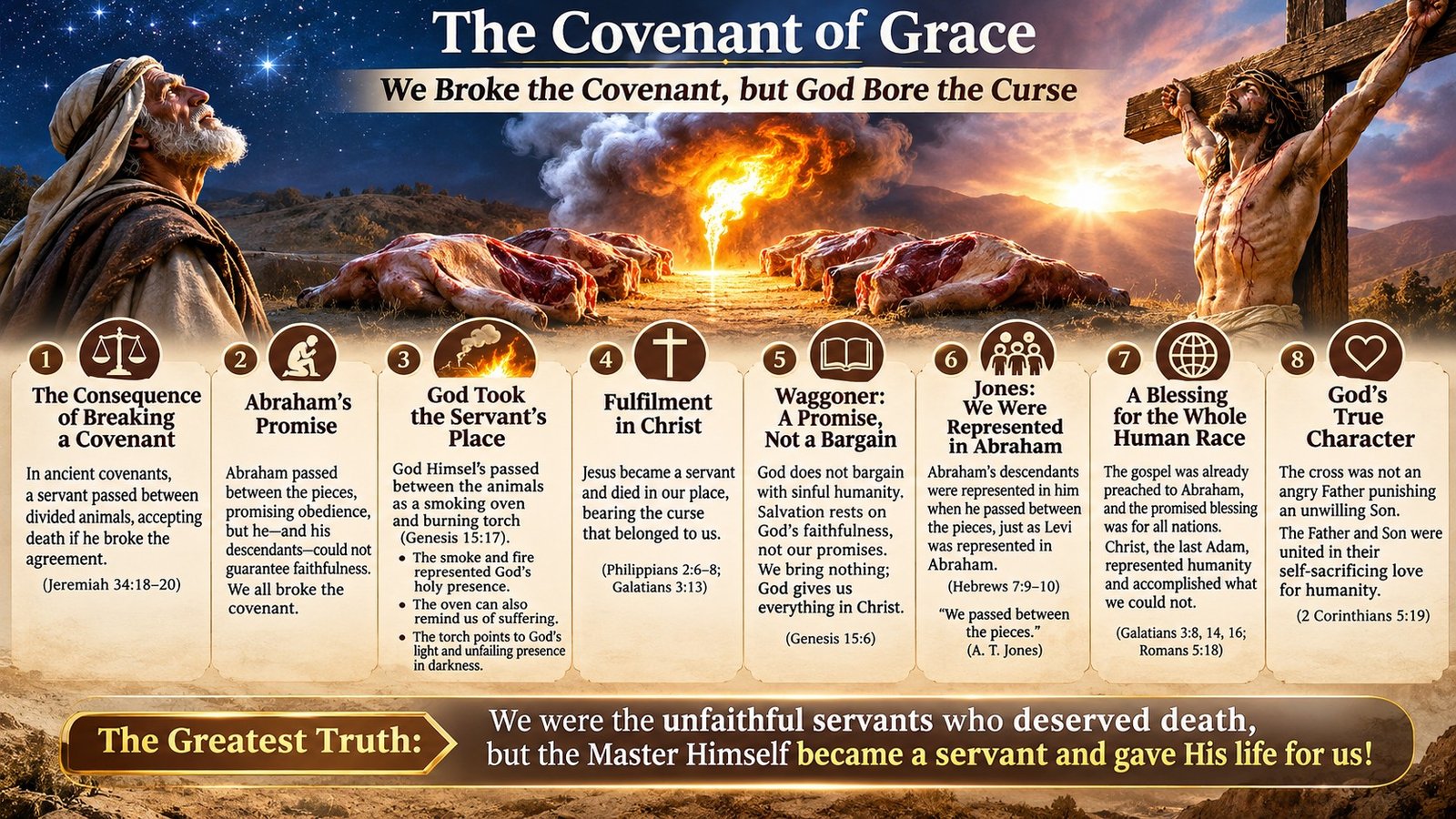
1. Breaking a covenant could mean death. In certain ancient covenant ceremonies, a subordinate ruler passed between the divided bodies of sacrificed animals, symbolically accepting death if he broke the covenant. The meaning was: “If I break my promise, let me suffer the same fate as these animals!” (Jeremiah 34:18–20).
2. Abraham promised obedience but could not guarantee it. According to Ellen White, Abraham passed between the divided animals, promising perpetual obedience (Patriarchs and Prophets, p. 137). But Abraham, his descendants, and the entire human race have failed to remain perfectly faithful to God. We broke the covenant and deserved the consequences of sin.
3. Astonishingly, God Himself took the subordinate ruler’s place! God passed between the divided animals as a smoking oven and burning torch (Genesis 15:17). The smoke and fire represented God’s holy presence, as at Mount Sinai (Exodus 19:18). The smoking oven can also remind us of suffering, while the burning torch points to God’s everlasting and self-sacrificing love, light of the world, and unfailing presence in darkness. The Master took the subordinate ruler’s place, solemnly guaranteeing His promise and revealing His willingness to bear the cost of our salvation.
4. Jesus fulfilled this extraordinary picture at Calvary. Although equal with God, Christ humbled Himself, identified Himself with our sinful condition and situation by taking our nature, and willingly died on the cross (Philippians 2:6–8). Paul declares: “Christ has redeemed us from the curse of the law, having become a curse for us.” (Galatians 3:13, NKJV). We were the unfaithful subordinate rulers who deserved death, but the Lord Himself became us and died for us!
5. Waggoner: God’s covenant is a promise, not a bargain. E. J. Waggoner explained that God does not bargain with sinful humanity because we cannot fulfil our part. Salvation depends on God’s faithfulness, not our promises of obedience. We bring nothing with which to purchase salvation; God gives us everything in Christ. Abraham was counted righteous because he believed God’s promise (Genesis 15:6).
6. Jones: We were represented in Abraham. A. T. Jones taught that Abraham’s descendants were represented in him when he passed between the divided animals, just as Levi was represented in Abraham (Hebrews 7:9–10). He declared, “WE PASSED BETWEEN THE PIECES” (Advent Review and Sabbath Herald, January 23, 1900, p. 57). The covenant was not merely about Abraham personally; it also concerned all in him who broke covenant and deserved death.
7. Christ represented the whole human race. The gospel was already preached to Abraham, and God’s promised blessing was intended for all nations (Galatians 3:8, 14, 16). As Jack Sequeira emphasised, Christ came as the last Adam, representing humanity in His life, death, and resurrection (Romans 5:18; 1 Corinthians 15:45). What humanity could never accomplish, Christ accomplished for us. Therefore, God passing between the halves of killed animals represented Christ, who accepted wages for the broken covenant (sins) for all sinners.
8. The cross reveals God’s true character. God never broke His covenant; we did. Yet He willingly bore the cost of our redemption. The Father was not an angry God punishing all of us in His Son. “God was in Christ reconciling the world to Himself.” (2 Corinthians 5:19, NKJV). The Father and Son were united in their self-sacrificing love for humanity.
A Strange Ceremony with an Extraordinary Meaning
Imagine Abraham standing beside several animals he had just sacrificed. Following God’s instructions, he had cut three of them in two and placed the halves opposite each other, leaving a passage between them.
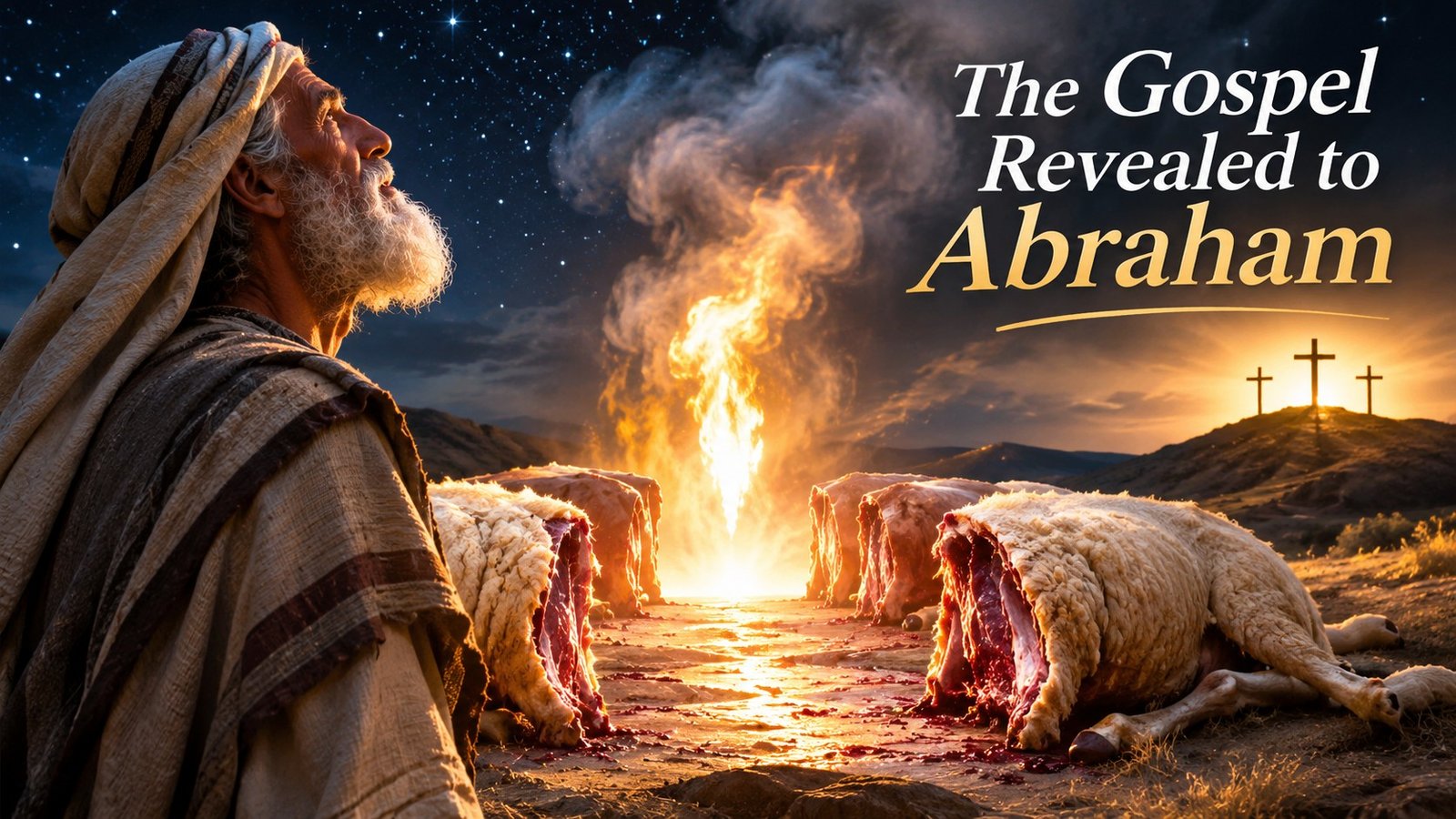
To us, this may seem like a strange and disturbing ceremony. But in Abraham’s time, such an act could carry a solemn meaning. It was associated with making a covenant, a binding agreement confirmed by an oath.
God had promised Abraham that his descendants would become a great nation. Yet Abraham and Sarah were growing old, and they still had no child. How could God’s promise possibly come true?
God took Abraham outside and told him to look at the stars. His descendants would become just as numerous. Then Scripture tells us something wonderful:
“And he believed in the LORD, and He accounted it to him for righteousness.” (Genesis 15:6, NKJV)
Abraham was counted righteous because he believed God’s promise, not because he had earned God’s favour through his own achievements.
But Abraham still wanted assurance that God’s promise would be fulfilled. Instead of rebuking him, God graciously gave him an extraordinary confirmation through a covenant ceremony.
What happened that night would point forward to the greatest revelation of God’s love in the history of the universe: the cross of Jesus Christ.
What Did Walking Between the Divided Animals Mean?
In the ancient Near East, certain covenants were confirmed by cutting animals into pieces and passing between them.
The ceremony could symbolise the terrible consequences of breaking the covenant. The person undertaking such an oath was, in effect, declaring:
May what happened to these animals happen to me if I break this covenant.
We find biblical confirmation of this practice in Jeremiah 34:18–20. God speaks of people who broke a covenant after passing between the pieces of a divided calf. Their unfaithfulness brought judgment upon them.
The essential point is that passing between the divided animals could symbolise accepting a solemn obligation, with death as the consequence of breaking it.
Why Did Abraham Pass Between the Pieces First?
Genesis 15 describes Abraham preparing the sacrifices and later records God’s presence passing between the pieces. However, the biblical account does not explicitly say that Abraham himself passed through them.
Ellen White provides this additional information:
“This being done, he reverently passed between the parts of the sacrifice, making a solemn vow to God of perpetual obedience.” (Patriarchs and Prophets, p. 137.)
Why did Abraham do this?
Because he was acknowledging his responsibility to obey God. As the human party to the covenant, he solemnly promised faithfulness to his Creator. But there was a problem. Abraham was a fallible human being. Although his faith was genuine, he could not guarantee that he would never fail. The Bible itself records occasions when his faith and obedience were tested and found wanting.
His descendants would prove even more unfaithful, repeatedly breaking their covenant commitments to God.
And the same is true of us.
We may sincerely promise God that we will obey Him, love Him, and never turn away from Him. Yet how often have we failed to keep those promises?
Abraham’s passage between the divided animals reminds us of humanity’s responsibility to obey God, but also of our inability to secure salvation through our own faithfulness.
If our eternal salvation depended upon our ability to keep every promise we make to God, what hope would any of us have? This is why what happened next is so extraordinary.
God Himself Passed Between the Pieces!
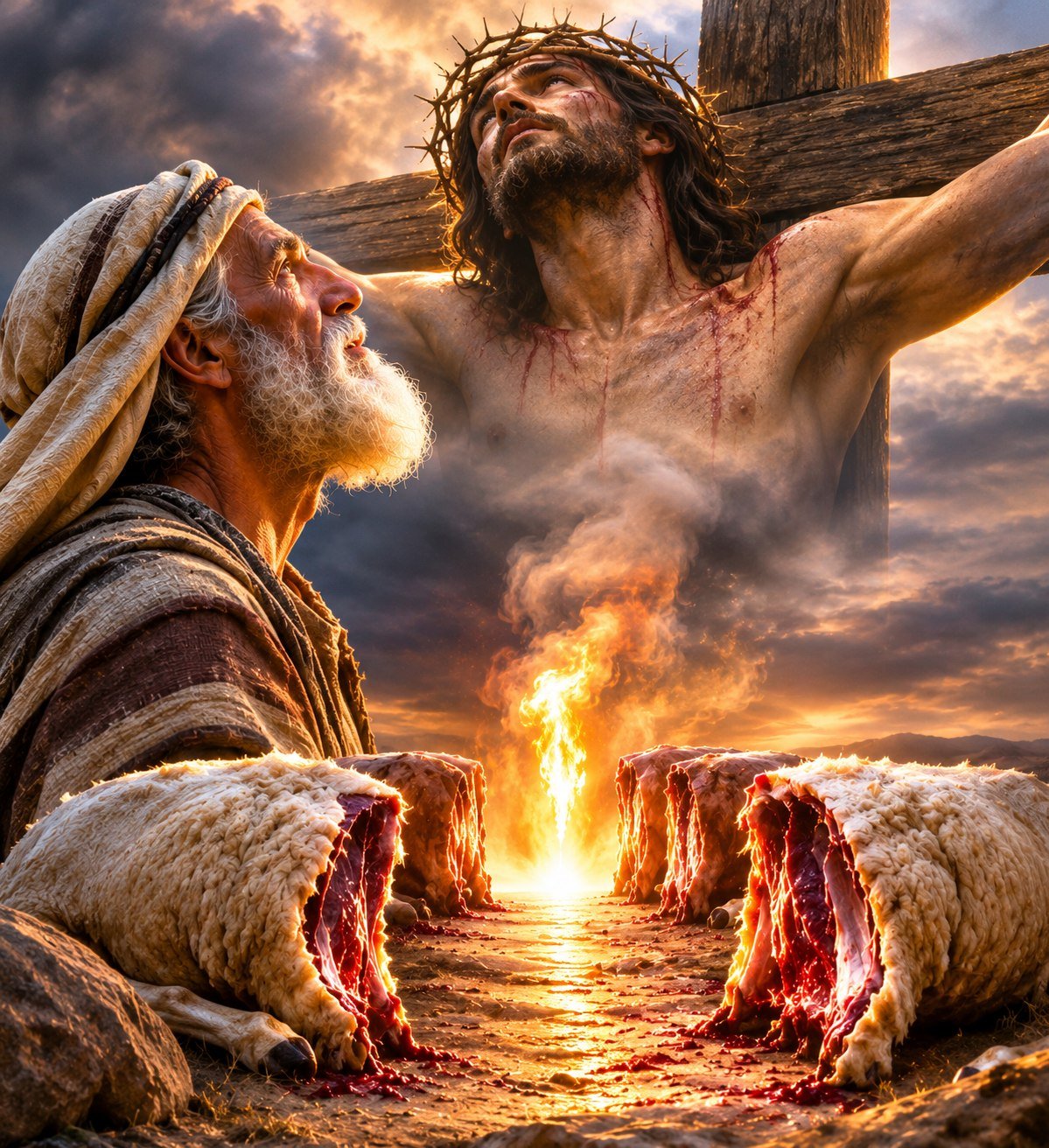
After Abraham prepared the sacrifices, he remained beside them, driving away the birds of prey. As the sun went down, he fell into a deep sleep, and a dreadful darkness came over him.
Then something astonishing happened:
“And it came to pass, when the sun went down and it was dark, that behold, there appeared a smoking oven and a burning torch that passed between those pieces.” (Genesis 15:17, NKJV)
The smoking oven and burning torch represented the presence of God.
It was God Himself who passed between the divided animals!
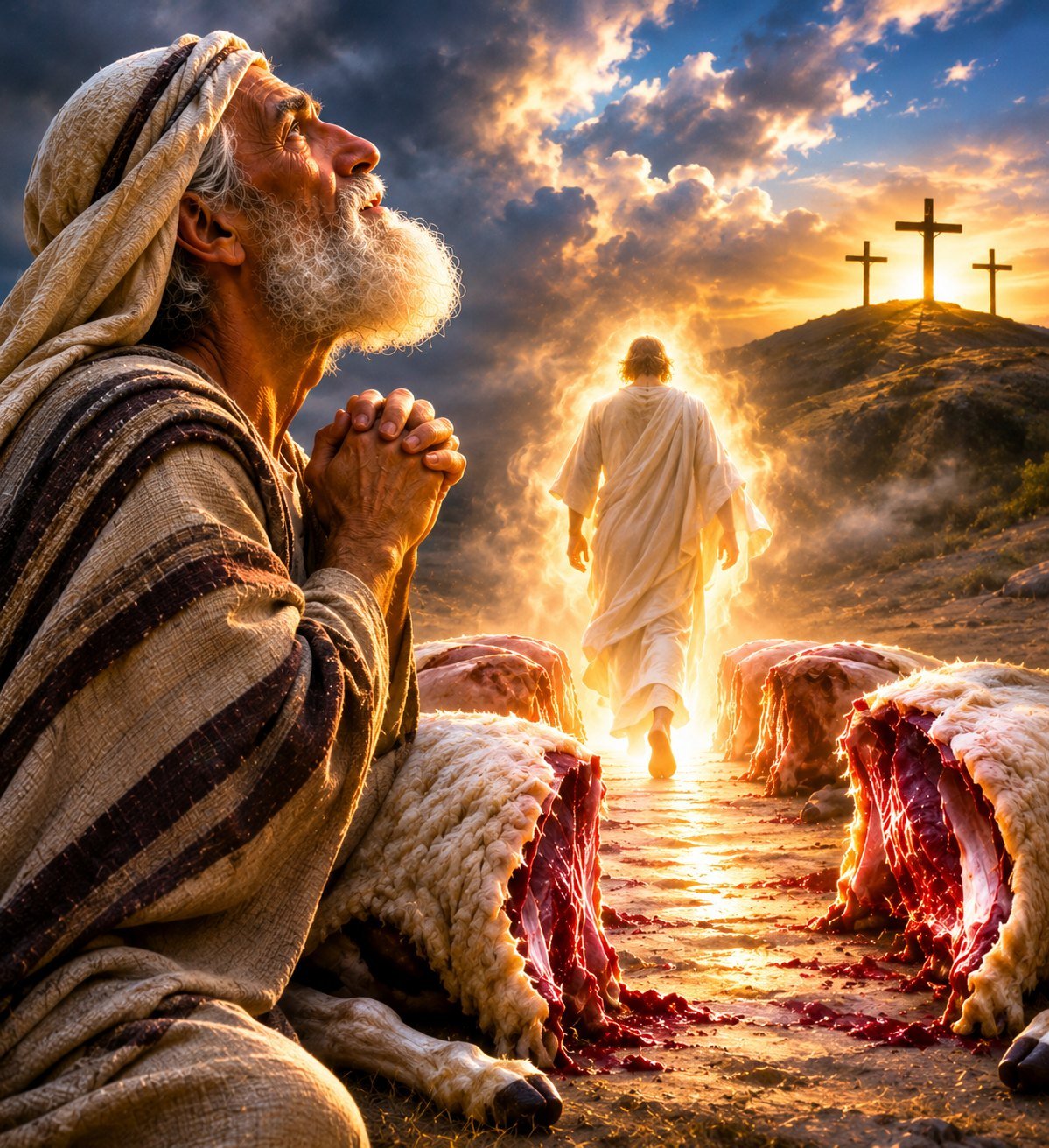
When we look at this ceremony in the light of the gospel, we discover something even more wonderful.
The God who knew that humanity would break its covenant commitments was nevertheless willing to bear the cost of our salvation Himself.
The Lord Took the Subordinate Ruler’s Place and Bore Our Curse
In certain ancient covenant ceremonies, a powerful king made an agreement with a subordinate ruler who served under his authority. It was normally the subordinate party who passed between the divided animals, symbolically accepting the penalty of death if he broke the covenant.
The meaning was solemn: May I suffer the fate of these animals if I prove unfaithful.
But in Genesis 15, something extraordinary happened. God, the supreme Lord of heaven and earth, Himself passed between the divided animals!
The Master took the subordinate ruler’s place! And this is precisely what we see in Jesus Christ.
Although He was equal with God, Christ willingly humbled Himself and took the form of a servant:
“But made Himself of no reputation (emptied Himself), taking the form of a bondservant (slave), and coming in the likeness of men.” (Philippians 2:7, NKJV)
But His humility did not end with becoming a servant:
“He humbled Himself and became obedient to the point of death, even the death of the cross.” (Philippians 2:8, NKJV)
We were the subordinate rulers who broke the covenant, yet the Lord Himself became us and willingly died for us! Paul makes the connection with Abraham’s covenant even clearer:
“Christ has redeemed us from the curse of the law, having become a curse for us.” (Galatians 3:13, NKJV)
The curse belonged to us, not to Christ. We were the unfaithful ones, not Him. Yet He willingly bore the curse so that the blessing promised to Abraham might reach all nations (Galatians 3:14).
The Lord took the subordinate ruler’s place. The innocent One bore the curse of the guilty. And the God whose covenant we broke gave Himself in Christ to save us (2Cor 5:19).
The Smoking Oven and Burning Torch: God’s Love Revealed at the Cross
Why did God reveal Himself to Abraham through a smoking oven and a burning torch?
Throughout Scripture, smoke and fire represent God’s holy presence. At Mount Sinai, God descended in fire, and smoke rose from the mountain like smoke from a furnace (Exodus 19:18). The burning torch also reminds us of the pillar of fire through which God guided His people in the wilderness (Exodus 13:21).
But the most remarkable part of Abraham’s vision was not simply the smoke and fire. It was that God Himself passed between the divided animals!
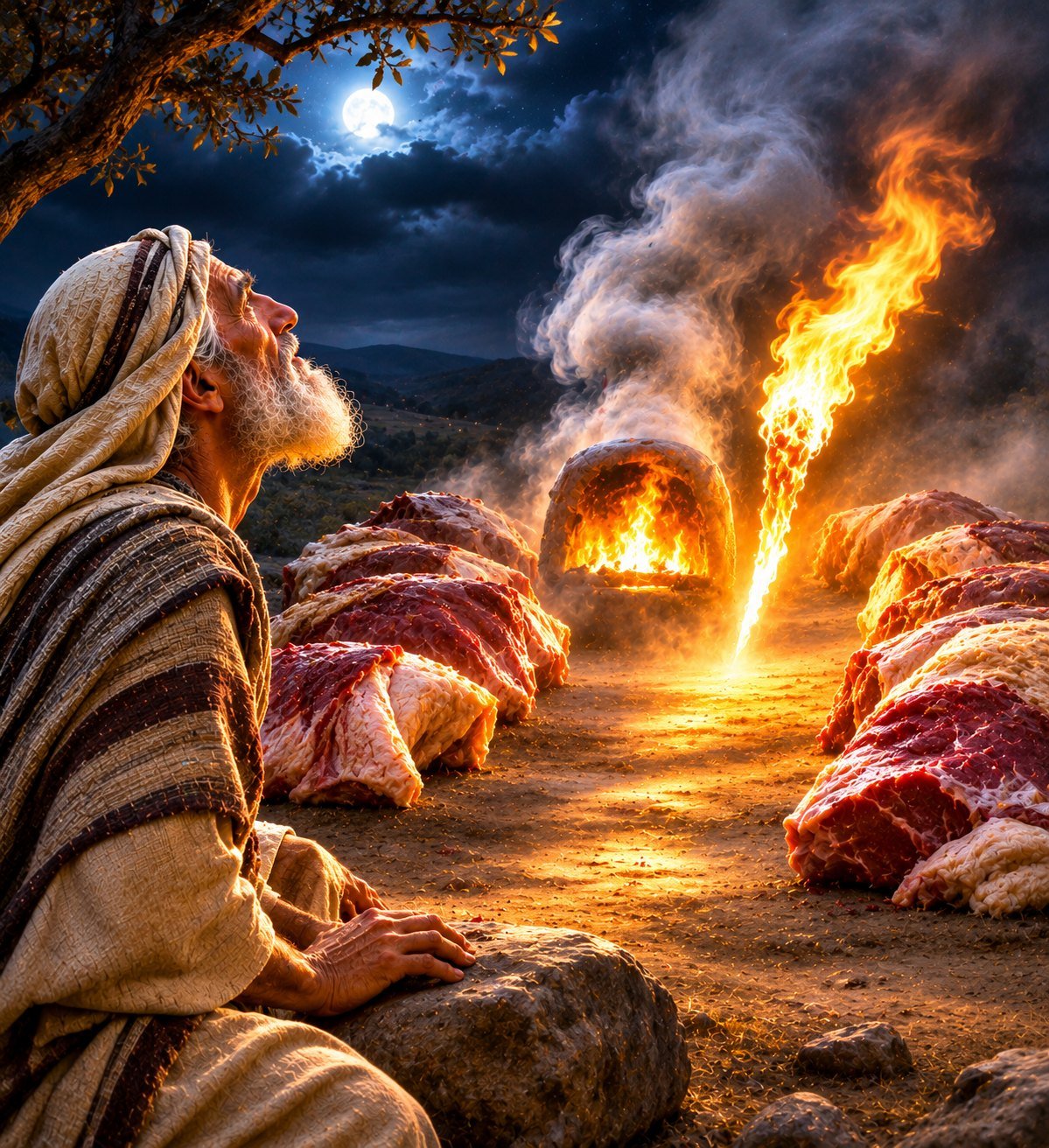
In ancient covenant ceremonies, passing between the pieces could symbolise accepting the terrible consequences of breaking the covenant (Jeremiah 34:18–20). Yet here the Creator Himself entered that solemn passage, voluntarily binding Himself to His promise.
What an extraordinary revelation of God’s love!
God knew that Abraham and his descendants would fail to keep their covenant commitments. Yet He was determined to fulfil His promise and save humanity, whatever the cost to Himself.
The deeper meaning becomes clear at Calvary. Paul writes:
“Christ has redeemed us from the curse of the law, having become a curse for us.” (Galatians 3:13, NKJV)
And Paul immediately explains why:
“That the blessing of Abraham might come upon the Gentiles in Christ Jesus.” (Galatians 3:14, NKJV)
The God who passed between the divided animals was revealing a love that would ultimately bear the curse of humanity’s broken covenant.
The smoke and fire reveal His holy presence. His passage between the pieces reveals His solemn commitment. And the cross reveals how far His love was willing to go.
The fiery furnace in Daniel 3 offers another beautiful illustration. God did not abandon the three Hebrews in the flames. A mysterious fourth figure appeared with them, traditionally understood by Christians as Christ (Daniel 3:24–25).
But at Calvary, Christ went even further. He did not merely stand beside us in our suffering. He willingly bore the curse of our sins to redeem us.
This is the astonishing gospel revealed through Abraham’s covenant:
We broke the covenant, but God remained faithful. We deserved the curse, but Christ bore it for us. And the love that led God to make His promise was the same love that led Christ to the cross.
The Darkness of Abraham’s Covenant and the Darkness at Calvary
There is another remarkable connection between Abraham’s covenant and the cross of Christ. As the sun was setting, Abraham fell into a deep sleep, and “horror and great darkness fell upon him.” (Genesis 15:12, NKJV).
Later, in the darkness, the smoking oven and burning torch passed between the divided animals, confirming God’s covenant (Genesis 15:17–18).
Centuries later, when Jesus was dying on the cross, a similar darkness appeared:
“Now from the sixth hour until the ninth hour there was darkness over all the land.” (Matthew 27:45, NKJV)
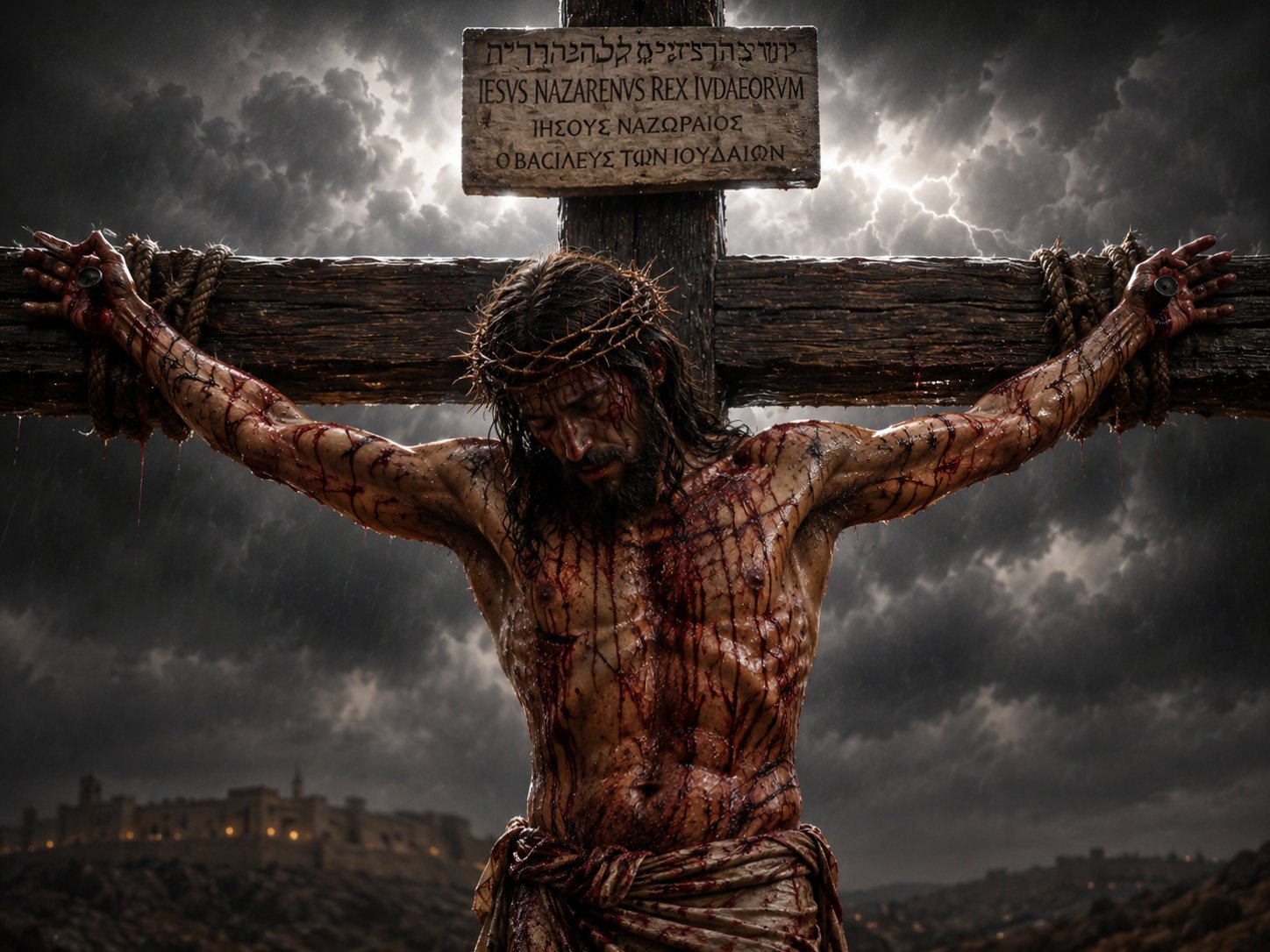
During those terrible hours, Christ cried out, “My God, My God, why have You forsaken Me?” (Matthew 27:46, NKJV)
The darkness surrounding Abraham’s covenant points to the darkness at Calvary, where Christ endured unimaginable suffering and bore the curse of our broken covenant.
In Abraham’s darkness, God confirmed His promise. In the darkness of Calvary, Christ bore the curse so that God’s promise of salvation could be fulfilled.
We Broke the Covenant, but God Took the Consequences
Here we must understand an important distinction.
God was never guilty of breaking His covenant. He had never sinned, never deceived anyone, and never failed to keep His promises.
We were the unfaithful ones. We rebelled against His love, rejected His will, and brought the terrible consequences of sin upon ourselves.
Yet God did not simply abandon us to perish.
Instead, in the person of His Son, He entered our fallen world and willingly bore the suffering and death brought about by our sins.
The prophet Isaiah expressed this wonderful truth:
“All we like sheep have gone astray; We have turned, every one, to his own way; And the LORD has laid on Him the iniquity of us all.” (Isaiah 53:6, NKJV)
Notice that we were the ones who went astray, but Christ was the One who bore our iniquity.
God did not take the blame in the sense of becoming guilty of our sins. He took responsibility for rescuing us and willingly bore the consequences of our guilt.
The cross was not an angry Father punishing an unwilling Son so that He could finally love humanity.
The Father and the Son were united in their love and purpose to save us.
As Paul wrote:
“God was in Christ reconciling the world to Himself, not imputing their trespasses to them.” (2 Corinthians 5:19, NKJV)
What an astonishing statement!
God Himself was in Christ, reconciling the world to Himself.
The cross was not something Christ did to persuade an unwilling Father to forgive us. It was the supreme expression of the love that the Father and Son had always shared for humanity.
E. J. Waggoner: God Does Not Make Bargains with Humanity
One of the clearest explanations of the Abrahamic covenant was given by E. J. Waggoner, one of the principal messengers of the 1888 righteousness-by-faith message.
In his book The Glad Tidings, Waggoner explains that God’s covenant with Abraham was fundamentally a promise, not a bargain between two parties contributing equally to salvation.
He writes:
“But God does not make bargains with men, because He knows that they could not fulfil their part.” (E. J. Waggoner, The Glad Tidings, 1900, p. 132.)
This is a remarkable statement. Human beings naturally think of a covenant as an agreement in which God promises to do something for us if we first do something for Him. But Waggoner explains that salvation cannot work this way.
We have nothing with which to purchase God’s favour. We cannot produce our own righteousness or undo our sins. Everything necessary for salvation must come from God.
Waggoner beautifully summarises this relationship:
“We give Him ourselves, that is, nothing, and He gives us Himself, that is, everything.” (E. J. Waggoner, The Glad Tidings, p. 132.)
Think about what this means for Abraham.
According to Ellen White, Abraham passed between the divided animals, promising perpetual obedience. His commitment was sincere, but his promise could never become the foundation of his salvation.
God’s covenant did not depend upon Abraham’s ability to produce righteousness. It depended upon God’s promise to provide righteousness through Christ.
Waggoner takes this argument even further. Explaining God’s oath to Abraham, he writes:
“He pledged His own existence, and with it the entire universe, for our salvation.” (E. J. Waggoner, The Glad Tidings, p. 134.)
“The Gospel was as full and complete in the days of Abraham as it has ever been or ever will be.” (E. J. Waggoner, The Glad Tidings, p. 136.)
The gospel, therefore, was not something God introduced after Israel failed to keep the law.
It was already present in the promise to Abraham, centuries before the giving of the law at Sinai.
The covenant of grace is not our promise to make ourselves righteous. It is God’s promise to make us righteous through Jesus Christ.
This is one of the most important truths recovered and emphasised in the 1888 message.
A. T. Jones: Abraham and His Descendants Passed Through Together
An especially interesting explanation comes from A. T. Jones, the other principal messenger associated with the 1888 message.
In an article entitled Abraham Did Pass Through, published in the Advent Review and Sabbath Herald on January 23, 1900, Jones acknowledged that he had previously been mistaken in saying that only God passed between the divided animals.
After reconsidering Ellen White’s description, he accepted that Abraham also passed through.
But Jones then developed an extraordinary idea.
He argued that Abraham’s descendants were represented in their ancestor when he passed between the pieces, comparing this with Hebrews 7:9–10, where Levi (who wasn’t alive yet) is described as paying tithes through (in) Abraham (because he was in his loins).
Jones therefore concluded that those who belong to Christ, and are consequently Abraham’s spiritual descendants, were also represented in that covenant ceremony. Because we all were in Christ and were put to death in Him (2 Cor 5:14; Rom. 6:6; 7:4; Gal. 2:20).
He wrote:
“WE PASSED BETWEEN THE PIECES” (A. T. Jones, Abraham Did Pass Through, Advent Review and Sabbath Herald, January 23, 1900, p. 57.)
Jones interpreted the ceremony as establishing a profound covenant relationship between God and His people, using the language of becoming blood brothers.
His interpretation emphasises that the covenant was not intended for Abraham alone. Through Christ, it embraces believers from every nation.
This is an important connection with Paul’s teaching that those who belong to Christ are Abraham’s seed and heirs according to the promise (Galatians 3:29).
Jones’s argument that Abraham’s descendants were represented in his passage is a theological interpretation, not an explicit statement in Genesis 15. Nevertheless, it highlights the representative character of the covenant and its significance for believers today.
Jack Sequeira: In Christ, God Fulfilled His Promise for the Whole Human Race
Pastor Jack Sequeira developed another important aspect of the gospel: the universal significance of Christ’s representative life, death, and resurrection.
His teaching helps us understand why the covenant promise to Abraham was never intended to benefit only Abraham, his family or one nation. God had promised Abraham that all the nations of the earth would be blessed through him (Genesis 12:3; Galatians 3:8).
Paul explains that the promised Seed through whom this blessing would come is Jesus Christ (Galatians 3:16).
But how could one Man bring salvation to the entire human race?
Sequeira explains this through the biblical teaching of the two Adams.
The first Adam represented humanity in its fall. Through his disobedience, sin and death entered human history.
Christ came as the second or last Adam, the new representative of the human race (1 Corinthians 15:45).
Paul expresses the contrast in Romans 5:18:
“Consequently, just as one trespass resulted in condemnation for all people, so also one righteous act resulted in justification and life for all people.” (Romans 5:18, NIV)
Notice the universal language: all people.
Sequeira understands this to mean that Christ’s obedience and sacrifice accomplished something objective for the whole human race, not merely for those who would eventually believe.
In Beyond Belief, he writes:
“God has legally justified all mankind in Christ” (Jack Sequeira, Beyond Belief, chapter 3, The Two Adams.)
This is the teaching often called universal legal justification.
According to Sequeira, Christ did not merely make salvation possible for humanity. As our representative, He accomplished an objective justification for the human race in Himself.
This does not mean that everyone will automatically be saved regardless of their response to Christ.
Sequeira distinguishes between what God has accomplished for everyone in Christ and what individuals personally experience when they receive Christ by faith.
In his understanding, the saving gift has been provided for all, but it can be persistently rejected.
This interpretation of Romans 5:18 is debated among Christian theologians. Many understand the justification described there as applying to those who are united to Christ by faith, rather than as an already accomplished legal justification of every individual.
Nevertheless, Sequeira’s teaching draws attention to something essential: Christ’s saving work is universal in its scope, and God’s love is directed toward the entire human race.
Now consider how this relates to Genesis 15. God’s covenant promise to Abraham was not ultimately restricted to Abraham’s physical descendants. Through Christ, the promised Seed, its blessing was intended to reach all nations.
And just as Abraham was unable to fulfil God’s saving purpose through his own strength, the human race was unable to redeem itself.
Only Christ, as our representative, could accomplish what humanity could never achieve.
In Christ, God took our humanity, lived the life of perfect obedience we had failed to live, and bore the curse of the law that we had broken.
This is the connection between the Abrahamic covenant and Sequeira’s understanding of universal legal justification.
Genesis 15 reveals God’s initiative and covenant faithfulness. Galatians 3 identifies Christ as the promised Seed and the One who bore the curse. Romans 5 presents Christ’s representative work in relation to the whole human race.
Together, these passages form a powerful picture of salvation accomplished by God rather than earned by humanity.
It should be noted that this connection is drawn from Sequeira’s wider teaching. It is not presented here as a verified statement by Sequeira specifically about the divided animals in Genesis 15.
The Gospel Was Already Preached to Abraham
Many Christians think that the Old Testament is mainly about law and obedience, while the New Testament introduces grace and salvation through faith.
But the apostle Paul tells us something very different:
“And the Scripture, foreseeing that God would justify the Gentiles by faith, preached the gospel to Abraham beforehand, saying, ‘In you all the nations shall be blessed.'” (Galatians 3:8, NKJV)
Notice those remarkable words: God preached the gospel to Abraham beforehand!
The gospel did not begin at Bethlehem or Calvary. It was already present in God’s promises to Abraham.
Abraham was counted righteous through faith. He believed that God would fulfil His promise, even when human circumstances made that fulfilment seem impossible.
The covenant ceremony revealed that God’s promise rested upon His own faithfulness, not upon human strength.
This does not mean that obedience is unimportant. True faith produces love and obedience. But our obedience does not purchase salvation. Salvation is God’s gift, received through faith and made possible by Christ.
The covenant of grace is therefore not primarily about what we promise to do for God, but about what God has promised and accomplished for us through His Son.
Why Was Abraham Asleep When God Passed Between the Pieces?
There is another remarkable detail in the story.
When the divine presence passed between the divided animals, Abraham was in a deep sleep.
According to Ellen White, he had already made his solemn promise of obedience. But when God passed between the pieces, Abraham was not participating in the ceremony.
He was not negotiating the terms of salvation or helping God fulfil His promise. God Himself took the initiative.
This beautifully illustrates an essential truth about salvation. We cannot save ourselves. We cannot erase our sins, overcome death, or restore our broken relationship with God through our own efforts. Only God can accomplish our redemption.
Abraham’s faith did not make God’s promise trustworthy. His faith simply accepted the promise of the One who could never lie.
Likewise, our salvation does not depend upon the strength of our promises to God, but upon His faithfulness to us.
The writer of Hebrews explains that God confirmed His promise to Abraham with an oath, giving believers strong encouragement to trust His unchangeable purpose (Hebrews 6:13–18).
Our hope rests not in how faithfully we have kept our promises to God, but in how faithfully God has kept His promise to save us through Jesus Christ.
Ellen White: Abraham Saw the Cross in This Covenant
Ellen White provides a remarkable explanation of this event in Patriarchs and Prophets, page 137. She explains that after preparing the sacrifices, Abraham himself passed between the pieces, making a solemn promise of obedience.
Later, when Abraham was in a deep sleep, the divine presence passed between the pieces, confirming God’s covenant.
She then connects the entire ceremony directly with the gospel:
“The plan of redemption was here opened to him, in the death of Christ, the great sacrifice, and His coming in glory.” (Ellen G. White, Patriarchs and Prophets, p. 137.)
What a wonderful thought! Abraham was not merely being shown the future of his earthly descendants. He was also being given a revelation of God’s plan to redeem humanity through Christ.
Ellen White further explains that Abraham saw the earth restored to its original Eden beauty, representing the final fulfilment of God’s promise. Elsewhere, she makes the connection between the Abrahamic covenant and Christ’s sacrifice even more explicit:
“The Abrahamic covenant was ratified by the blood of Christ.” (Ellen G. White, Patriarchs and Prophets, p. 371.)
This confirms that the covenant with Abraham was part of the everlasting covenant of grace, whose ultimate foundation was the sacrifice of Jesus Christ.
David R. Tasker: God Put His Own Life on the Line
One of the most striking explanations of Genesis 15 was written by Adventist Old Testament scholar Dr. David R. Tasker in his article The Gospel That Came to Abraham, published in Dialogue, volume 22, number 1, 2010, pages 24–26.
Tasker explains that in certain ancient treaties, a subordinate ruler would pass between the divided animals before a more powerful king. By doing so, he accepted the consequences of breaking the covenant, symbolically declaring that he deserved to suffer the fate of the slaughtered animals if he proved unfaithful.
But in Genesis 15, something unexpected happened. The supreme Ruler, God Himself, passed between the divided animals. Tasker interprets this as God symbolically accepting the consequences of humanity’s future covenant-breaking. He concludes with these unforgettable words:
“And He did—at Calvary.” (David R. Tasker, The Gospel That Came to Abraham, Dialogue, 22:1, 2010, pp. 24–26.)
This is a profound interpretation of the cross. God knew that humanity would prove unfaithful, yet He voluntarily entered the covenant and ultimately bore the cost of our redemption.
Other biblical scholars understand God’s passage primarily as an oath guaranteeing His promise to Abraham, especially the promise concerning the land.
The Cross Vindicates the Love and Character of God
Perhaps the most important lesson of this entire story is what it reveals about God’s character. Ever since sin entered the universe, God’s goodness, justice, and trustworthiness have been challenged.
Satan has sought to portray God as selfish, demanding, harsh, and unwilling to sacrifice anything for His creatures. But what do we see in Genesis 15 and, even more clearly, at Calvary? We see a God who does not merely demand sacrifice from others. He is willing to sacrifice Himself.
We see a God who does not abandon His unfaithful creatures. He comes to rescue them. We see a God whose love is not conditional upon our ability to make ourselves worthy of His favour. The apostle Paul expresses this beautifully:
“But God demonstrates His own love toward us, in that while we were still sinners, Christ died for us.” (Romans 5:8, NKJV)
Christ did not die because we had become good enough to deserve His love.
He died while we were still sinners.
And this is precisely what makes the cross such a powerful answer to Satan’s accusations. The cross reveals that God is not selfish. He is the very opposite of selfishness. His love is so great that He willingly gave Himself to save those who had rebelled against Him.
At Calvary, God’s justice and love were not in conflict. Both were revealed in His determination to deal with sin while offering salvation to sinners. The cross shows how terrible sin really is, but it also reveals how wonderful God really is.
As Jesus Himself declared:
“Greater love has no one than this, than to lay down one’s life for his friends.” (John 15:13, NKJV)
And Christ went even further. He died for us while we were still His enemies (Romans 5:10).
Conclusion: We Broke the Covenant, but God Bore the Cost
When Abraham witnessed the smoking oven and burning torch pass between the divided animals, he was witnessing something far greater than a promise about the land of Canaan.
He was being shown, through a solemn ceremony familiar to his world, the extraordinary faithfulness and love of God.
Abraham had promised obedience, but he was only human. He could not guarantee that he or his descendants would always remain faithful.
God, however, could be trusted completely. As Waggoner explained, God does not make bargains with humanity. His covenant is a promise of what He Himself will accomplish.
As Jones emphasised, the covenant with Abraham also embraced his spiritual descendants. And as Sequeira explains, Christ’s representative work has a universal significance, reaching far beyond Abraham’s physical descendants to the entire human race.
The promise to Abraham was ultimately fulfilled through Christ, who bore the curse of sin and opened the way of salvation to all humanity.
We were the unfaithful ones, but God remained faithful. We broke the covenant, but Christ bore the curse. We were guilty, but He took our place. We deserved death, but He gave His life so that we might live.
This is the gospel revealed to Abraham, proclaimed by the prophets, fulfilled at Calvary, and offered freely to every human being.
And perhaps the most wonderful truth of all is this: God did not give His Son to make Himself love us. He gave His Son because He had always loved us. The covenant ceremony of Genesis 15 pointed forward to the suffering Saviour on Calvary. And the cross reveals the heart of the God who made that ancient promise.
The One who had every right to condemn us loved us so much that, in Christ, He gave Himself to save us.
That is the God Abraham trusted. That is the God revealed at the cross. And that is the God we can trust with our salvation.